Writing for Social Justice: Dear Alice

Dear Alice,

If you are reading this, it is because yet again the Great Listener has deemed my seeking worth finding. I am placing in this letter a few questions which I hope to learn your thoughts. It is May 31, 2022. I am sitting with news of massacres. I have spent the last few months with your writing, rereading The Color Purple and rewatching the movie of the same name. Checking your website for new blog entries.

Earlier this month, I interviewed you after reading your newest book, Gathering Blossoms Under Fire, 50 years of your journal entries. I am a little over halfway done with The Same River Twice, playing Quincy Jones’ Color Purple movie soundtrack while I write you this letter with dreams of someday hosting a live listening party with you and Quincy as our special guests. We would chat music, the Color Purple soundtrack, and review copies of Quincy’s new book–12 Notes on Life and Creativity, alongside your extensive catalogue. Big dreamer. I know.

I wrote your staff requesting an opportunity to share space with you at the beginning of the year, and I get that I am one of a billion people who have that same prayer, so when I didn’t hear back I was not astonished, just patient until Sara Lomax Reese, head of the oldest local radio station in Philadelphia, calls me up and asks if I’d like to interview Alice Walker, I say: YES! And then cut a step. Yes to the Great Listener. Wave my hand in the air. Yes to fate. Close my eyes. Inhale. Yes to Alice.

You won’t believe this but on December 31, 2021, I wrote down all my wildest dreams for 2022 and right on top of my list, under complete my memoir, was your name–have tea and chat with Alice Walker. The tea didn’t happen just yet (but I have hope). Our chat began at 6 pm on May 12th at the Comcast Technology Center. But how does one squeeze a lifetime of questions into a 45-minute interview where I must share half the questions with a co-host and 15 minutes of the interview on audience questions. The day before the interview, my sister said, “Just make sure you have one good question because that might be all you get.” And she was almost right. I got to ask you about love, flowers, reparations, finances, and fame. But I still have so many other questions.

I will not write them all here today. Just one: I want to know your visions for the future of this world and how you see us getting there. After reading the journal entries in Gathering Blossoms, I am challenged on how to teach folks, especially young folks, how to practically apply the lessons the book so eloquently layers in. For instance, I just finished watching a documentary on Hulu about XXXtentacion, a young rapper with millions of fans who was shot dead at 20 years old during the height of his tumultuous career.

I wanted to understand XXXtentacion more because my 18-year- old son damn near worships him. “XXXtentacion to me is what Alice Walker is to you,” my son explains. In the documentary, XXXtentacion, like Mister______, like your grandfather, has a deep mix of undesirable qualities alongside great fragility. These qualities are attractive to millions of young people who listen to XXXtentacion and feel heard. And I am aware that in Philly, it’s the 16–24-year-olds who are both the most at risk (highest murder rate, highest suicide rate, highest rape rate) and share the highest opportunity for growth. I am aware that the young person who shot and killed elders in a Buffalo grocery store was 18 years old. That the young person who shot and killed babies in a Texas elementary school was 18 years old. That the cadre of conductors working in our shops come there to restore their belief in connection. And these are young people who just came out of years spent in the captivity of a global pandemic. I just want to know from your perspective how to love them better. How to reach the otherwise unreachable. How to get as many of your books into desiring hands as possible. How to get us writing letters like Nettie. And freely expressing ourselves like Shug and Sofia. And restoring ourselves like Celie.

I believe that your books are medicine, a soul rejuvenating elixir that will protect and guide us through the days to come if we read, hear, and apply the wisdom.

signed a revolutionary petunia,

jeannine


For the last 10 years, Jeannine Cook has worked as a trusted writer for several startups, corporations, non-profits, and influencers. In addition to a holding a master’s degree from The University of the Arts, Jeannine is a Leeway Art & Transformation Grantee and a winner of the South Philly Review Difference Maker Award. Jeannine’s work has been recognized by several news outlets including Vogue Magazine, INC, MSNBC, The Strategist, and the Washington Post. She recently returned from Nairobi, Kenya facilitating social justice creative writing with youth from 15 countries around the world. She writes about the complex intersections of motherhood, activism, and community. Her pieces are featured in several publications including the Philadelphia Inquirer, Root Quarterly, Printworks, and midnight & indigo. She is the proud new owner of Harriett’s Bookshop in the Fishtown section of Philadelphia.
The Jewel of Berks County

There are ten categories of competitive yodeling.

When I ask why, she purses her lips.

If it has to be said at all, she wants it yodeled.

Dot is dot.

She’s a daughter of the dotters of wisdom

and winner of the Under Twenty Hill to Hill.


Her voice carries all the way

to Lyons from Blue Mountain Motors,

where she’s bending over the hood,

leaning in, yodeling to the engine

in her polka-dot Capris,

the Jewel of Berks County,

trying to get the old Dodge tuned.


Even now, as far off as Macungie,

old men on benches reading children’s books

with very hard eyes and almost no lips,

on hearing her voice look up

and press their tongues to gums for spit,

bracing themselves for the eleventh yodel—

part rescue and part lift,

part egress and part crypt,

part substance and part mist and itch.


And when I dream I’m Paul Cezanne,

a poor man who’s overspent on wallpaper

with no way to make ends meet,

her voice is there to comfort me.

Listen, she says.

With two large fries from Sheetz,

one for now and one as needed,

you can forget about l’Orangerie

and picnic baskets along the Seine.

La Santé has actual food fights

with Apollinaire and the Algerians,

with Jean Genet and Paul Verlaine.


Ken Fifer‘s poetry collections include After Fire (March Street Press) and Falling Man (Ithaca House). His poems have appeared in Philadelphia Stories, Barrow Street, Epoch, New Letters, Ploughshares, and The Literary Review. He has a Ph.D. in English Language and Literature from The University of Michigan.

WE DIDN’T WIN THE LOTTERY

& now I’m google searching something like

good songs to recommend for someone trying to kick


heroin & clearing the oldest iPhone I have, deleting

my past life photo by photo, stopping at the one you sent me


when you had your first baby & I was at the Kimmel

listening to a live jazz band with Alex, & your son,


he was all tubes & wrinkled, so I kept the picture

to myself. he will be three in April & it feels like he should be


younger. the internet keeps recommending the same song,

some same stale drama, so I play it once, again,


but it’s all puppets

with their strings visible, like,


we’re on two street & you’re

pulling on my pocket & you’re asking


for the flask & I don’t even remember telling you

that I brought one.


my dad’s dad hated the mummers.

he called them feather merchants.


everything feels like giving up.

let’s steal a rifle & pick off the next


& then the next planet’s moons one by one

until we’re even, until it’s simple or simple again.


I really thought we had a chance this time.

I just had that feeling—you know?


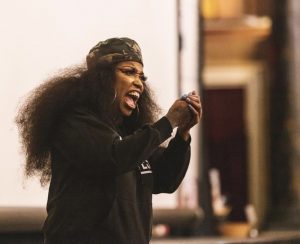
Kimberly Ann Southwick is from Cherry Hill, New Jersey and currently an Assistant Professor at Jacksonville State University. She is the founder and Editor in Chief of the literary journal Gigantic Sequins. Her full-length poetry collection, Orchid Alpha, is forthcoming from Trembling Pillow Press. Find her on twitter tweeting about being a Philadelphia Eagles fan: @kimannjosouth.

Grief

I wanted to grieve

but the garden

was in such a good mood

and the bubbly

blue sky

kept calling C’mon! C’mon!

and I swear

the wind lifted me

like a toddler

onto the burning back

of the sun

galloping in such

a wild and

unbroken way

that not once

did I think of

my mother’s ashes.


Andy Macera has received awards from Plainsongs, Mad Poets Review and Philadelphia Poets. His work has also appeared in Pearl, California Quarterly, Connecticut River Review, Drunk Monkeys, Gyroscope Review, Straight Forward, Sierra Nevada Review, Old Red Kimono, Passager and other journals. He has lived in West Chester, Pennsylvania since 1998.

Rapture

i wish the world would stop for me.

in its tracks, never felt such weight

gracefully crumble onto its palms.


i’ve added a couple of pounds

since i started walking the hypotenuse,

driving my life with triangular wheels.

what can i say—i came out of the womb horizontal.


how to lessen the weight?

starve yourself of these earthly pleasures.

shelter a cocoon and live and laugh all you want,

but wait until the world doesn’t glare anymore,


then the roads are open to rapture.

run as you will—lose more weight,

but swallow that impossible feeling.

it will be weightless gain.

full, impossible to hate again.

i swear i don’t miss the empty well,

where every sip of water is an echo in a spacious cave.


to be perfect is to cut skin and bone

and i no longer have to do so.

i am ever-molding surface no more.

my thinning love rhymes with pounds and mounds

and one day i’ll be loved and give love,

but still wonder if the jawline is sharp enough to cut.


when there is a way to measure how heavy,

learn to step down from the scale

and keep your worth (or weight) inside you.

after all, even a word sounding as nasty as rapture can mean bliss.


王潇 / Evan Wang is a 15-year-old poet from King of Prussia whose work has appeared in Juste Milieu, Bleeding Soul Poetry, The National Poetry Quarterly, etc. He is the recipient of the Youth Appreciation Award and a featured artist in the Our America Now festival. Evan is spellbound by the catharsis of the moving language and worships the pens of Savannah Brown and Ocean Vuong.

where something happens

how, at the trolley stop, we all have a common mountain.

morning like a tall pine the day starts with, strong and silent;


how heavy scarves and hats and gloves sleep

on our bones. that the silver tracks pull around the last stop,


by a wash-and-fold where something is always moving,

soap and water hiding the colors of soaked clothes.


how standing here is so easily understood: the patience

or impatience, the idleness of hands. how it’s acceptable


just to know you’re in the place where something happens,

where the route ends and then again, begins. it’s possible


to ride with spare coins, barely treasure, the range of it

like peaks and valleys: to creek or city, to streets and homes.


how the waiting here is a good thing, how everyone rushes

just to be in this, this very, this very happening place.


Rachel Betesh is a nurse and a gardener who writes poems – at a wooden desk in a 112-year-old house, with the window open. Her poetry has been featured in The New Yorker, long-listed for the 2022 emerging poet prize at Palette Poetry, and is forthcoming in Brink magazine. She rides the #13 trolley through Philadelphia.

Bensalem

You take Street Road back to the world,

pine needles fall nearby.

These places still exist, revisited

like a box of wilted baby pictures in a storage locker.

On a Sunday, you take Broad to Vine to I-95

and you take the exit to Pain and Mercy

and go to the places that kill you.

It all stands before you confident as ghosts.

320 Pine Court is still there and you drive slowly

and out of the passenger side window you see yourself

sprinting out the door

and you see yourself

walking behind Holly

over the pine needles

to the bus stop and the third grade

and your Oldsmobile is not where mom parked it

and a steakhouse replaces the woods you rode your bicycle through

and a wrought-iron gate keeps Street Road from Beech Court

and you want to call Kourtney Melendez and tell her she was the best friend you ever had

but you know that Cyprus and Spruce and Willow

are not to be revisited today.


Greg Probst is a teacher, writer, and filmmaker. He is the recipient of the Pam Perkins-Frederick Memorial Scholarship for the Marriage of Art and Poetry and the Dr. Allen Hoey Memorial Scholarship for Short Fiction. His writing has been featured in The Centurion, The Temple News, Hyphen, Rathalla Review, and through the Teachers Institute of Philadelphia. Probst is currently pursuing an MFA degree at Drexel University where he will be teaching first-year composition and creative writing.

Free postcard from the saint shrine

Deliciously dark confession

booths and big lightless

pupils with golden

grapes and dead guy

in a glass box. Everyone

so so still. So silent.

Backs of their heads

devotional. Guy restocks

the votives. Clink,

clink, the color glass.


Mary Zhou (they/she) is an artist based in Philadelphia. Their poetry is also forthcoming in Oversound and Philadelphia Poet Laureate Trapeta B. Mayson’s Healing Verse Poetry Line. Poetry, both read and written, has carried them through the last two years. You can find them online at marzhou.com.

’69 Mustang

To read ’69 Mustang by Joshua Barnes, click HERE.


Joshua Barnes was born and raised in Boyne City, Michigan, and is now a Philadelphia transplant with a career as a Nurse Manager. His poetry has previously appeared in Kairos Literary Magazine, The Bloom, and has been featured on the Lake County Arts Council website. He’s been a devoted comic book nerd since he was ten. When not writing or working, he can be found reading poetry and horror fiction, perfecting his handstands, or binge-watching Drag Race.

Kulikitaka

Dominicano soy!
Dominicano soy!
Dominicano soy
in a city of cold.

‘toy cruz’ao
in my heart.
My body, made of bark,
and hair of mango fibers
is rooted to the orderly lines
painted on perfect concrete.

Mi sangre de zapote
doesn’t move with
easy mountain river speed, here
in the
fluorescent white
banks of
fluoride streams.

No puedo bailar
como los arboles de palma en la brisa,
because in the mirror
I see a rigid oak tree
wearing a stiff shirt with tight collar—pero

Dominicano soy!
in the choking alleys
of montaña tall skyscrapers.

Dominicano soy!
barred outside the wide
finca de arroz bright
fashion avenues and high
art boutiques and white
spaces.

Dominican soy!
morenito con sol
in the cold.

Dominicano soy!
while American.


Michael Angelo Abreu is a leaf. He takes frequent walks through the Wissahickon woods, musing about life and its many particulars, such as love, happiness, suffering, and spiritual growth. These kaleidoscope ideas find themselves splashed across his poetry. Through his exploration of writing, he seeks not only to further develop his voice but also to obtain a deeper understanding of who or what he is.