West Philly, Clarendon, and the World Between Aisles

Yesterday, my younger brother arrived in Philadelphia and immediately asked if I would make my signature oxtail stew. It was a last-minute request, and normally I would have made my way to Reading Terminal Market, the bustling temple of food and humanity. I’ve been going there since childhood, clutching my mother’s and Aunt Lillian’s hands, learning from an early age that food is culture and archive.

But I didn’t have the energy for the trip downtown, not yesterday. Earlier in the day, I had treated myself to a date with the library. I wandered the cookbook section of the Parkway Central Branch, then sat and listened to Miles Davis in the music department, drifting through the quiet like a rambunctious prayer. That building, designed by Julian Abele, a Black architect whose genius shaped this city, has always been my sanctuary. As kids, my cousin Desi and I would ride our banana- and apple-seat bikes from Overbrook to the main branch, leave them unlocked outside, and disappear into research and imagination. We had branches closer to home, but that grand building called to us before we could articulate why. We always felt it was ours. More than fifty years later, stepping inside still feels like stepping into possibility.

So yes, the date was lovely and nourishing in its simplicity. And afterward? I was tired. The thought of diving into Reading Terminal’s whirl of tourists, produce vendors, fishmongers hollering orders, the smell of spices and hot oil and all that history, I simply couldn’t do it. My body said no, and I listened.


A friend suggested a nearby meat market that many of our Caribbean and African community members frequent. What I found was a small, unassuming Dominican market with fluorescent lights, narrow aisles of spices and produce, a radio blasting merengue, and a young cashier dancing between customers like joy was his second job.

And there, behind the meat counter, stood Mr. Shottie, the unexpected sovereign of this tiny, protein-rich kingdom. A youthful Jamaican elder with a Clarendon accent thick enough to stop you mid-sentence, he ruled that butcher station like a gentle chieftain. He was part comedian and part culinary philosopher, a food griot. As he talked me through the oxtails and offered preparation tips, he insisted I take a bottle of his personal sauce: Shottie’s Jamaican Sauce. He said it was a much-needed ingredient for oxtails. I found myself leaning in not just to hear him, but to hear inside him.

Because in that voice, in the music of it, there was history layered like sediment. The rolling brogue of long-ago Irish and Scottish tongues, carried through colonial overseers and prisoners transported against their will. Beneath that, pulsing, grounding, steady, were the rhythms of the Akan and Igbo, those ancestral beats that refused to disappear. A New World language, born of rupture and survival, dancing on top of a Dominican merengue track in a West Philly butcher shop.

It was enchanting. It was ordinary. It was a miracle disguised as a grocery errand.

There I stood, surrounded by plantains and Scotch bonnet peppers, by chicken feet arranged like delicate relics (yes, I bought them; collagen is my ally and my cane thanks me), realizing this was not just a shopping trip. It was a reminder that history is not behind us. It is right here, humming and swaying between metal shelves and glass coolers, still unfolding, still calling roll.

In that modest market, I felt the whole Atlantic world in motion, the diaspora speaking back to itself, seasoning memory, stirring pots, laughing, surviving, feeding each other forward.

Sometimes you don’t need a Reading Terminal to feel the world. Sometimes the world meets you at the butcher counter, smiling, accent thick with centuries, handing you a bottle of sauce and a lesson in who we are.

And my brother, tasting that stew infused with memory and migration, grinned wide and said, “This is it. Home, found in a bowl.”


Octavia McBride-Ahebee is a Philadelphia-based poet, writer, and educator whose work centers migration, Black Atlantic history, memory, and place. A longtime teaching artist and community collaborator, she has contributed to multiple anthologies and cultural projects connecting Philadelphia to West Africa and the broader African diaspora. Her work often bridges literature, visual art, and public history, with a focus on overlooked narratives and intergenerational storytelling. She is currently engaged in several writing and arts initiatives rooted in community and social justice.


Fern

Fern had gotten herself lost.

The bookstore she’d worked at for over a decade had gone out of business, and what she assumed would be a brief blip of unemployment advanced towards month three with no end in sight. To help fill the excruciating amount of free time she now had–and to avoid the sound of her husband Nick’s breathing–she would take long walks through their labyrinth of a town. She wore her largest pair of sunglasses and kept her hat pulled low to ward off both the cold and any neighborly attempts to engage her in conversation. Ignoring street signs and the time, she walked aimlessly, allowing herself to slip into a pleasant mental fog. For at least a few hours, she could be a ghost, untethered to the responsibilities of the living.

She’d been listening to a true crime podcast when one of the hosts cut off mid-word, as if they too had fallen prey to the Silver Lake Strangler. She unearthed the phone from her pocket; even through her glove, it felt like an ice cube. The battery had been at fifty-two percent when she left the house, but the temperature had plummeted twenty degrees with the setting sun, and it must have been too much for her ancient phone.

None of the street names looked familiar. Robbed of the maps app she relied on, she picked a direction at random, only to second-guess herself after a few blocks. She doubled back, turning down a different street, but after walking half a mile, she suspected she had been right the first time. An elderly man collecting his mail called out to see if she needed help. Fern picked up the pace, pretending not to hear him.

By the time she returned home, she’d lost feeling in her fingers and toes. Her snot had frozen solid like her nostrils were a pair of popsicle molds. All she could think about was cocooning herself on the couch and zoning out to the new game show she’d discovered in which contestants had to eat the most pickles in a minute. She found the slow-motion instant replays– jaws gnashing, saliva and pickle juice misting the air–particularly revolting and had binged three seasons in the past week. She felt a pang of guilt whenever she looked at her stockpile of unread books, but they reminded her too much of her dearly departed bookstore, a problem she didn’t have with People vs Pickles.

When she got inside, Nick was pacing, frazzled. He must have been trying to reach her. Fern flushed with guilty pleasure at seeing him look so concerned. “Fucking finally,” he said. “Did you forget we’re seeing the play?”

She scoffed. “Of course not.”

It wasn’t that she had forgotten so much as willfully chosen not to remember. They would be driving almost an hour away to see some comedy written in the 70s called Blanket Statement. At least, she assumed it was a comedy. She often had trouble deciphering Nick’s interpretation of things. This was the same man who had once described Jurassic Park as a “heavy watch.” They didn’t know anyone involved with the production, and neither of them had been to this theatre before, or even the town where it was located. All Nick would say when pressed was that he had seen a production of the play when he was younger, and though he couldn’t remember what it was about, he wanted to see it again.

“When did you want to leave?” she asked.

“Like–ten minutes ago.”

She gestured to her coat and hat. “Well, I’m ready.” She looked down at his bare feet and raised her eyebrows. It was crucial that she didn’t give him an inch at the beginning of an argument. It had been one of the best tactics she’d learned from him.

“Do you have the spare charger?” she asked as he yanked his scarf taut, briefly strangling himself. He nodded and made an affirmative grunt before shooing her out the door. After they’d been driving for a few minutes, and his jaw looked less clenched, she asked about the charger.

“It’s in my backpack.”

She twisted to look in the backseat but only saw a carpet of drive-thru bags and crumpled napkins. “Where?”

“Huh?”

“Where is your backpack?”

“In the living room.”

She stared at her husband’s dumb face as the wind whistled against the windows. He fiddled with the heat, oblivious. After mentally counting down from five, she said, “My phone is dead. So that doesn’t really help me now.”

He continued adjusting the heat. “Goddamn, it’s cold.” He glanced at her. “Ok. Well, we’re late. What do you want me to do, turn around? We’re already on the parkway.”

“It’s fine.”

“You want me to stop and buy a charger?”

“No. It is fine.”

“Ok. So…” He shrugged. “Not like you can use it during the show, anyway. Can’t be checking your Insta or whatever in the middle of a play.”

Her shoulders climbed up to her ears. “When have I ever done that?”

“You literally had your phone out for half the movie last night.”

“That’s not the same thing.”

“It’s disruptive.”

“We were watching it at home.”

“Disruptive to me, Fern.”

Fern bit the inside of her cheek. Most of their recent attempts at communication ended up like this. It seemed to invigorate Nick. He would do squats and push-ups while they argued, then sleep like a baby, while she would be stuck awake, vibrating with adrenaline. Since she’d lost her job though, she had been eating and sleeping and talking and breathing mostly out of routine. If nothing else, fighting with Nick reminded her she was still alive.

Nick turned on the radio, and Fleetwood Mac filled the car. Before Fern could place the song, he changed the station. They listened to the entirety of an ad for a car dealership. He changed it again. After changing stations fourteen more times, he turned off the radio.

Fern stared at her door and considered unbuckling her seatbelt, tugging the handle, and rolling out onto the parkway. Would Nick notice or just keep driving? Maybe he’d slam on the brakes and race back to save her, only for a truck to come along and smear them both across the pavement like butter on toast. She found this image uncomfortably arousing and tried to think of something else.

“Son of a bitch,” Nick muttered. She looked over to see him shifting in his seat, digging a free hand into his pockets. She asked what was wrong. “I think I left my phone at home.”

“You know you can’t check your Insta during the show.”

He ignored the comment and changed lanes. “I was gonna use it for directions. Is your phone completely dead?”

“Yes, it’s as dead as it was ten minutes ago.”

He rolled his eyes. “Christ, I’m just asking.”

She pressed on her eyelids with her fingertips. “So…should we stop and buy a charger?”

“It’s fine. I know how to get there.” He then added, “Sorry,” but he said it like a teenager forced to thank someone for a gift they hate.

They drove in silence. Fern’s window had frosted up, so she drew a frowny face with her index finger. She then added a crude penis pointing at the face like a finger of accusation. Nick said nothing.

Light flurries divebombed the windshield. Nick turned on the wipers and took the next exit, slowing the car to a crawl. “Keep your eyes peeled for any signs for Ghostlight Players.”

She looked out her window. The penis she’d drawn pointed to a thrift store, a hair salon, a coffeeshop–all of them dark. “Is the theatre on this road?” she asked.

“I don’t know. Maybe.”

“So…” Fern said before stopping herself. She had recently read an article that said the key to a relationship is reframing. It isn’t you against your partner, it’s the two of you against the problem. Couldn’t she try to be the bigger person?

“Hey,” she said brightly. “Remember when you said you knew how to get there?” He didn’t respond, but his face scrunched in on itself, and she knew she’d hit her target. At the next light, he hooked a left followed by another, immediate left. “Why don’t you stop and ask for directions?”

Nick peeled one hand off the steering wheel and made a broad, sweeping gesture. “Do you see anyone to ask?”

When you see someone, ask them.”

Nick nodded a single, slow nod, punctuated by a loud exhale through his nostrils.

A few blocks later, Fern spotted an elderly couple shuffling their way down the sidewalk, their arms interlocked and heads bowed together. Did they cling to each other because it was icy, or did they always walk like this, still crazy for each other after all these years? She studied them from her sideview mirror as they drove past and decided the former would be more romantic. Maybe they were rarely affectionate anymore and holding onto each other would spark some memory from when they were young and first dating. Those early, easy days when you fall for the outline of the person, the ideal version they allow you to see, and by the time you realize there’s a discrepancy between the real person and the façade, it’s too late. You’ve convinced yourself the one you fell for must still be in there somewhere, if you could only dig them out again.

“Shit,” Fern said, snapping out of it. “There was a couple.”

Nick jerked his head back and forth. “Where?”

“Back before the light.” She pointed behind them. “We should ask if they know where the theatre is.”

“We already passed them.” He cut her off as she began to respond. “I’ll find it. I am going to find it.”

A headache blossomed behind Fern’s eyes. She wiped her finger drawing from the window and pressed her damp palm against her forehead. If her calculations were correct, they’d been in the car for seventeen hours. As the streets blurred into one another, she silently counted the seconds, willing herself to say something–anything–once she reached a minute. Then two minutes. Then five. She stayed silent. Since she wasn’t following through on the action anyway, she upped the ante. In one minute, she would scream. In two minutes, she would poke Nick in the eye. In three minutes, she would grab the steering wheel and yank–

Nick swerved suddenly into a crowded church parking lot, slamming on the brakes. Fern pitched forward, her seatbelt biting into her shoulder. Nick turned off the car, unbuckled his seatbelt, and hurled himself out, slamming the door behind him. He returned almost instantly, smacking his palm against the windshield.

“Let’s go!”

Fern opened her door and looked past him, confused. “Is this a church?”

“Yeah, the theatre’s in the basement.”

This only raised more questions, but Nick was already powerwalking away. She jogged to keep up with him. “Is the play religious?”

“No, just–come on.”

They ran, the brisk air slapping Fern awake. A confused burst of adrenaline had flooded her system. After being in the car for so long, she wanted to keep moving, maybe never stop. She felt a brief, manic impulse to open the church doors with a karate kick and immediately wiped out on a patch of ice.

Inside the church, a handwritten sign for Ghostlight Players directed them down a set of stairs, Nick barreling ahead as Fern limped after him. The basement vestibule was empty aside from a teenager wearing a pineapple bowtie. He cheerfully informed them there could be no late seating. “That’s fine, kid.” Nick looked past him at the door to the theatre. “We don’t mind, we’ll be quiet.” The teen held up both hands as if to physically restrain Nick and repeated himself, a little less cheerful.

As Nick began to argue with him, Fern wandered off to inspect a poster for Blanket Statement taped to the wall. It was a drawing of a group of people, a sheet thrown over them so that you could only see their legs and feet. It made the show look like one of those old bedroom farces, which would make this a far more progressive church than the one Fern had been forced to attend as a child.

A piercing scream startled her. She froze for a moment before remembering the play had already started. It must have been one of the actors. She pressed an ear against the wall but could only make out a furious garble.

A few months into working at the bookstore, an older coworker of Fern’s had a nervous breakdown in the travel section. Elaine was a small woman in her fifties who moved through the aisles as if worried she’d damage the books by breathing too loud. On a random Tuesday, with seemingly no provocation, she began tearing books off the shelves, screaming, “ENOUGH!” over and over, so many times the word seemed to lose its meaning. Customers stared, their faces etched with pity and mild fear, but Fern had been pinned to the floor by a curious envy. Elaine left the next day on permanent leave of absence. Fern fixated on the incident for years, wondering what happened to her, until last spring, when she spotted her in the frozen foods aisle at the grocery store. It felt like running into a celebrity. She followed at a distance as Elaine finished her shopping, paid for her groceries, and loaded the bags into her van. Fern watched her drive away, disappointed. The last thing she expected was for her to still look so utterly normal.

Nick stormed over. “The little asshole won’t let us in until intermission.”

A small pang of hope. She might make it home in time to catch the new People vs Pickles. “So…we’re leaving?”

He squinted at her. “We’re already here.”

Fern’s headache knocked on the inside of her skull a few times to remind her it hadn’t gone anywhere. She sat heavily on a nearby bench. It was twelve minutes past eight, and she hadn’t eaten since lunch. “Maybe we could get some food and come back?”

“And miss the start of act two?” Nick shook his head and sat down next to her. “Nope. No way. I’m not moving from this spot.”

Fern turned to ask the boy in the pineapple bowtie what happens in act one, but he had disappeared inside the theatre. She looked back at Nick, but he was slumped against the wall, eyes shut and air whistling out of his left nostril, somehow already asleep.

She wanted to check her phone, but since it was dead, she studied Nick’s face. She tried to picture him when he was younger. Maybe he’d gone to see the play with his parents, all of them laughing together, some precious memory that he hoped to recapture with her? Or he saw it with a high school girlfriend who had given him a discreet hand job in the darkened theatre, and that was why he couldn’t remember a single goddamn thing that happened in the play. She fought the urge to flick his ear.

Time crawled. Fern’s stomach growled, her back ached sitting on the bench, her leg throbbed from where she’d fallen in the parking lot, and her headache bonked around the inside of her skull like a goldfish in its bowl. She tried to remind herself that this would eventually end. The interminable waiting, the play she had no interest in seeing, the long drive home with Nick – these were all finite. As she continued to pull on this thread, she decided almost everything fell into this category. Her complacency, the self-loathing because of her complacency, the thrum of annoyance she felt at Nick’s existence, the weight in her chest like a block of ice dragging her down–this would all end at some point.

Of course, the same could be said for the few bits of happiness she scavenged throughout the days. Or her job at the bookstore, for that matter. And then there were those fleeting moments of levity with Nick, like when a shared memory would spark laughter between them, a quick tug as if they were holding the ends of a length of rope, and all they had needed was the slightest resistance to remember they were still connected. This, too, never lasted.

Fern slipped a hand inside Nick’s coat and fished out the car keys. Aside from a brief snort, he didn’t stir. She rose from the bench and hobbled up the stairs back out into the parking lot. Snow dusted the cars like powdered sugar. A gust of wind blew across the lot, and she shivered with pleasure as it whipped flurries around her. Within a minute, she could be on the road. She could get food, or go home, or just pick a direction and start driving.

She stood there, unmoving. She could go anywhere, do anything. But which choice was right?

Were any of them wrong?

A faint shouting rose above the wind. She paused, listening. There it was again. She followed the voices, feet crunching over frost as she circled the church. Rounding the corner, she spotted a line of windows along the ground. She crouched and peered through into the church basement.

Rows of metal folding chairs faced the wall, upon which a sagging, linty curtain had been hung. A single, harsh spotlight illuminated a dining table covered in an old floral tablecloth. Six pre-teens sat around the table in the middle of a furious debate. They wore ill-fitting suits, jacket sleeves sliding up and down as they gesticulated. Fern tried in vain to make out what they were saying. Was this supposed to be a business meeting? Were they half a jury? She still had no idea what the play was about, but one thing was clear. These kids could not act.

They shrieked their lines, pulling exaggerated faces as they jockeyed for attention. If there had been a director, they had seen the writing on the wall early on and abandoned ship. Fern scanned the captive audience as they rustled their programs and shifted in their seats. She suspected most of them were the actors’ families.

She couldn’t wait to tell Nick. He would have to agree to leave now. Or maybe it would be better to say nothing, wait until the second act to rub it in his face that he accidentally brought them to some kind of youth theatre program. But as she continued to watch, she felt oddly charmed by the kids. What they lacked in talent, they somewhat made up for with an aggressive enthusiasm. Whoever they were, they loved being on this stage with every fiber of their being. If someone tried to stop the show, this pack of ferals would devour them.

One of the girls stood and slammed her hands on the table. With her round cheeks and diminutive size, she closely resembled an incensed chipmunk. She circled the others, jabbing a finger of accusation at each of them in turn. Fern watched, mesmerized, as the girl stepped on her chair and launched herself up onto the table. As she landed, though, the tablecloth skidded out from under her. She kicked a foot back to steady herself, causing the table’s front legs to lift off the floor like a rearing horse.

Fern’s hands flew to the window, pressing on the freezing glass so hard she worried it might crack. The girl pinwheeled her arms as she fought to keep her balance, the odds fifty-fifty whether the table would right itself or continue to pitch back and send her flying. She hovered there for longer than seemed possible, suspended between the two outcomes. A strangled cry caught in Fern’s throat as the table rocked back, then forward, then back again. Being in proximity to a church must have been influencing her, because she found herself praying for the first time in years. Don’t let her fall…don’t let her fall…don’t let her fall…

But to her surprise, the girl didn’t show a trace of fear. Instead, her face beamed with delight, like she knew nothing could hurt her up there. As if this was all just part of the show, and when she was done playing pretend, she’d return to the real world intact.


Jeff Ronan is a writer and actor living in Brooklyn. His fiction has appeared in over a dozen publications including The Saturday Evening Post, Neon Door, The Journal of Compressed Creative Arts, Abyss & Apex, Twenty-Two Twenty-Eight, and Metastellar. His play Bunkmates is published and licensed by Concord Theatricals. Jeffronan.com
 

Time is a Snake’s Tongue by MaryAnn L. Miller

Review By Sarah Van Clef

MaryAnn L. Miller, in Time is a Snake’s Tongue, writes of a specific incident in a specific place and time in the author’s life, yet she reaches readers’ hearts with her words and images, which echo into our present day.

Birds are a favorite image of Miller’s. In several poems, they appear as high schoolers in a marching band walking in a parade, as survivors against the threat of overdevelopment; signs of the future. For example, a red-tailed hawk is driven from its territory by a housing development but returns to kill bunnies in a backyard in the poem called “Red Tail.”

Miller’s poems consider the impact of racism on an individual, adeptly merging scenes from the past with present consciousness. Her poem, “My Armor Is Silence,” encapsulates the sentiment of this chapbook: My verbs are wishes. / As long as I’m / quiet, I will be okay. / My mouth is shut / but my skin shouts.

Other poems reference prejudice in its varied forms. Miller also uses images of a bird to tell the story of a human in “Trans-specied.” The first stanza begins with a ‘tweet’ from the cradle. Later, the character jumps, ‘trying to get more air.’ Near adulthood, he grows ‘wings’ and a ‘feathered neck.’ Even though the nest calls to him, he flies, speaking with his ‘beaking lips,’ searching for the food of a hawk, ‘rodents, hatchlings, small bony fish.’ His transition is complete. There’s the suffering of Native Americans at the hands of deceitful white people, youth taunting the aged, and the fear of Communism knocking at the door during the Cold War. There are Catholic nuns frightening children, white Italian parents’ dread of a dark-complected child, and memories of racism that prohibited a neighbor from drinking from a family water glass.

Miller employs creative punctuation and line breaks, underscoring the social critique integral to the pieces. There is meaning between the commas and periods. There is meaning between the words that becomes recognized only by reading aloud. It takes some effort to understand the message, the truth in these words, these images, these poems. Just like it takes effort to recognize injustice, past, present, and ongoing.


Sarah Van Clef is a the Reviewers Editor of Philadelphia Stories. She is an Adjunct Professor in English Writing and Community Literacy across multiple colleges across New Jersey.

Circle of Hope by Eliza Griswold

Review By Beth Toner

To read Beth’s review of Circle of Hope, click HERE.


Beth Toner is a nurse, writer, and erstwhile theater nerd who still hasn’t figured out what she wants to be when she grows up. As a strategic communications professional, she has spent the last 30 years writing other people’s stories, and now she’s writing her own. She worked as a stringer for community newspapers early in her career, when 20 dollars felt like a fortune for sitting through municipal meetings and writing coverage only the township supervisors read. Her nerd’s heart is particularly proud of having her short story, “Homemade,” selected for publication in Star Trek: Strange New Worlds VI. She has written and performed several versions of her solo show, Beautiful Disasters, at the Reading (PA) Five-Minute Fringe Festival, the Harrisburg Fringe Festival, and Caveat in New York City. Beth is also a second-career registered nurse with a passion for exploring how storytelling can prevent professional burnout and improve patient care. When she’s not working her day job or volunteering at the local free clinic, you can find her walking trail races while younger, faster folks greet her with “good job!” and “on your left!” She lives in Pottstown, Pennsylvania with her husband and their son.

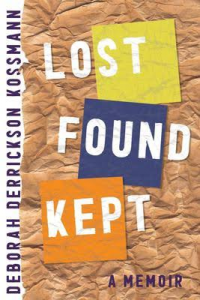
Lost, Found, Kept by Deborah Derrickson Kossmann

Deborah Derrickson Kossmann won Trio House Press’s inaugural 2023 Aurora Polaris Creative Nonfiction Award for LOST FOUND KEPT: A MEMOIR (January 2025). Book Pages named it one of the Best Memoirs of 2025. Her essays, feature articles and poetry have appeared in The New York Times, Bellevue Literary Review, Nashville Review, Memoir Monday, Psychotherapy Networker and PSYCHE to name a few. Deb is a clinical psychologist who lives in Havertown, PA. For more info: http://lostfoundkept.com


Review By Jennifer Rivera

Deborah Derrickson Kossmann’s Lost, Found, Kept is an exceptional memoir that blends unflinching honesty with such tenderness that you come away not only knowing the author’s story but feeling it in your bones. At its surface, this is a book about confronting a parent’s compulsive hoarding and all the logistical, financial, and emotional chaos that comes with it. But beneath that is something far richer: a layered exploration of love, family bonds, boundaries, and the objects, both literal and symbolic, that tether us to our histories.

From the opening pages, Kossmann draws us into her dual role as both a clinical psychologist and a daughter caught in an intricate web of loyalty and frustration. She doesn’t shy away from showing the reader the grim realities of her mother’s home: the overgrown yard, the blocked windows, the absence of running water, but she never reduces her mother to her illness. Instead, she paints her as a multifaceted, often witty, sometimes infuriating, but ultimately human figure who shaped Kossmann’s life in profound ways. This balance between exposing hard truths and maintaining compassion is one of the memoir’s greatest strengths.

The book is divided into three sections, “Lost,” “Found,” and “Kept,” which reflect the arc of Kossmann’s emotional and practical journey. In “Lost,” we get vivid childhood recollections from growing up in Cherry Hill, New Jersey, to the move from one house to another, and the complicated dynamics with her father, stepfather, and sister. Kossmann’s vividly described details bring these memories to life, whether it’s the smell of her mother’s Wind Song perfume or the exact shade of pink shag carpeting in her teenage bedroom. These scenes not only ground the reader in time and place but also reveal the roots of the family patterns that later manifest in the hoarded home.

In “Found,” Kossmann shifts into the present-day urgency of managing her mother’s unraveling situation. Here, the memoir takes on the rhythm of a real-time crisis, as she and her sister navigate unpaid bills, disconnected phones, and long-shut-off utilities. Her professional training as a psychologist helps her maintain a certain level of calm, but Kossmann doesn’t hide the toll it takes. She finds humor in these moments, too, a dry, knowing wit that keeps the narrative buoyant even though the circumstances are grim.

“Kept” is arguably the most moving section, in which Kossmann reflects on what’s worth holding onto.  Not just in terms of physical belongings, but also memories, values, and relationships. She takes inventory of the items from her mother’s house that matter to her: childhood photographs, a four-poster bed, family jewelry, and pieces of art with personal history. These tangible keepsakes become metaphors for the emotional throughlines of the memoir. In choosing what to preserve, she models for the reader how to honor the past without being consumed by it.

What makes Lost Found Kept especially compelling is Kossmann’s narrative voice. She writes with a kind of intimate clarity that makes the reader feel trusted, as though they’ve been invited not only into the family’s living room, but into the guarded spaces where family stories are kept under lock and key. Her prose is graceful but never flowery, sharp when it needs to be, and suffused with empathy even when her patience is tested.

While hoarding has been examined in popular culture, often with a sensationalist or voyeuristic lens, Kossmann’s memoir refuses to exploit. Instead, it offers a rare and humane perspective that acknowledges the pain of mental illness while still recognizing the agency and dignity of the person living with it. She doesn’t pretend that love makes the cleanup easier, nor does she suggest that resolution is neat or complete. Instead, she leaves space for the reader to sit with the mess, both the physical disorder and the emotional turmoil, to appreciate the strength required to face it.

The final pages of Lost Found Kept leave the reader with a quiet sense of hope. Not from a tidy fairy-tale ending, but a steadier kind born from doing the hard work of showing up, setting boundaries, and choosing what to carry forward. The memoir lingers, not just for its story but for the way it challenges the reader to reflect on their own “lost,” “found,” and “kept.”  What people, places, and possessions define us.

Deborah Derrickson Kossmann has crafted a memoir that is at once deeply personal and universally resonant. It’s about hoarding, yes, but it’s also about survival, forgiveness, and the enduring threads of connection between a mother and daughter. Honest without being cruel, emotional without tipping into sentimentality, Lost Found Kept is a beautifully written testament to the idea that in the wreckage of the past, there are still treasures to be found.


Jennifer Rivera is a Latina writer and certified dog trainer. She received her MFA in Creative Writing from Monmouth University in May 2024. Her prose and poetry have been featured in The Monmouth Review.

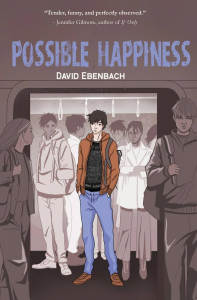
Possible Happiness by David Ebenbach


Photo of David Ebenbach by Justin Gellerson

Reviewed By Mary Miller

In 1989, junior year, Jacob Wasserman would be transformed from a quiet, shy, and, in his own estimation, “two-dimensional” loner to a member of The Pack. In the fluid manner of teenage relationships, a well-timed joke leads to a new friendship, which leads to a last-minute party invitation, which ultimately engenders the formation of a friend group that will become the focus of Jacob’s life, along with the inevitable group drama, romantic entanglements and jealousies, competition, and power struggles. Unspoken roles and responsibilities are fluid, and change quickly and often without a clear cause or purpose. The one nonnegotiable is loyalty to the group. Jacob, with a fractured family and limited social experience, is particularly in need of and vulnerable to the kind of togetherness The Pack implies.

The Pack is solidified, and complicated, through before-school hangouts, marathon evening telephone calls, parties thrown and attended, and nights on the dance floor at the iconic alternative/punk club Revival, whose siren song drew hordes of Gen X teenagers and young adults to the city in the late 1980s and early 1990s, and which provided a venue for all the drama, angst, and, as Ebenbach aptly describes in a running theme throughout his novel, the happy/angry joy/rage embodied in much of the music of that time.

His increasing enmeshment in The Pack leads to challenges for Jacob. He wants to maintain his pre-Pack work friendships, but is not sure how to do so. He is drawn to one girl in The Pack, but so are others—including his closest friend. The economic differences between Pack members are stark. Inevitably, the Pack members pair up into couples, either by desire or default, threatening the integrity of their bond. At the same time, Jacob needs to navigate his pre-Pack world, which is marked by complex family relationships, self-doubt, and debilitating anxiety. Belonging to The Pack, and having his first serious girlfriend within its confines, sometimes felt healing, yet sometimes led to new struggles that awakened Jacob’s anxiety, when he “would feel a keen howl of loneliness; or he would walk down his street and suddenly wonder whether he belonged there; or he would just wake up feeling a sense of being disconnected from the world.”

In Possible Happiness, Ebenbach provides a visit back to the high-school years, and for those of us who were Philadelphia-area teenagers in the late 1980s or early 1990s, reading this book is like stepping into a time machine. It rings true. Younger readers, as well as older ones, will connect with the narrative as well. This insightful coming-of-age novel provides a timeless look at that strange era in all of our lives of inevitable change, when we try on personalities like clothing while we try to figure out what feels right as we decide who we are going to be, and our friendships define us more than do our families. The writing is honest; the characters feel like people we know, or knew.

There are few seasons of life as consequential and poignant as the high-school years. Life for a t  teenager is full of confusion, marked by periods of clarity; sadness, punctuated by moments of joy; and isolation, highlighted by sporadic episodes of belonging. Not only the inner demons unleashed during this time, but also myriad outer forces, define these years: imperfect families, social minefields, treacherous high-school halls. The friends made in those years shape us and reveal us; they change us, sometimes dramatically, sometimes rapidly. Despite widely varying experiences, locales, and encounters, there is one universal: the high-school years, and those with whom we spend them, are transformative.

In a recurring theme, Jacob has always wondered what lies at Fern Rock station. He has never taken the train that far, but he has always wondered, with such a bucolic name, what would be at the end of that train line: an actual rock blanketed by ferns? More city? Something else? Yet in the end, how much does it matter? As with this point in time in Jacob’s life—an unfinished time of evolution and change, during which “he couldn’t help feeling that he was still very much getting to know himself, and that there was probably a lot more to come”—the mystery may be an inextricable element of its essence.


Mary Evangelisto Miller (left) is a freelance writer and editor based in Bucks County. She has been self-employed as a medical editor for 22 years. Mary holds a bachelor’s degree in Mass Communications and English from Temple University and a master’s degree in English and Publishing from Rosemont College.


Pawpaw by the Lehigh

we find them low along the bank

mottled gray and yellow

dangling in late August

like forgotten lanterns

swaying in trees


I snap open my penknife

score the skin along its seam

fruit flares open

gold as a candle

flickering in church


seeds slide from pulp

slick as river stones

we both know

tomorrow you leave

where I cannot follow


I split the fruit

hand you half

juice runs bright

warm across your fingers

the last gift I can offer


the Lehigh drifts on

indifferent

while black seeds

cool in my palm

heavy as the silence between us


Baskin Cooper is an award-winning poet, visual artist, and multidisciplinary creator based in Chatham County, North Carolina. His work spans poetry, songwriting, sculpture, screenwriting, and voice acting, weaving together visual, narrative, and musical elements. He holds a PhD in psychology and previously lived in Cork, Ireland, experiences that often shape his explorations of folklore, lyricism, and personal history. His poems have appeared in Verse-Virtual, ONE ART: A Journal of Poetry, Ink & Oak Lit, and others. His debut collection, The Space Between Branches, is currently seeking publication.


Sniff

When my father failed

at frying an egg

on the occupational therapy stove,


forgetting to press in the knob

before turning it to medium-high,


then cracking the shell

too hard on the skillet’s rim

so half the white

dribbled down the outside

and onto the burner,


then struggling to reach a plate

from the nearby cupboard

on account of the plastic tubes

coiling out of his kidneys,


the pouches of urine

velcroed to his hips

like pistols in a holster,


the social worker suggested

he be discharged to a sniff

instead of going home.


And when I looked puzzled,

she clarified a sniff

is a skilled nursing facility,

commonly abbreviated

S-N-F, or sniff.


Sniff, I repeated, my mind

pondering that acronym

turned onomatopoeia


for the sound we make

to clear tears from our noses,


or the method by which

we detect the smell

of something suddenly burning.


Doug Fritock is a writer, husband, and father of 4, who was born and raised in the suburbs of Philadelphia, but now lives in Redondo Beach, California. His work has appeared or is forthcoming in Rattle, Prime Number Magazine, and Whale Road Review among others. He is an active member of Maya C. Popa’s Conscious Writers Collective. 


Visiting

On the walk to my grandmother’s grave,

my mother says she’d like to be buried in a cemetery

by a lake where the family could go to have picnics.


I nod, like I understand cemeteries. Like I understand

my mother’s need to visit and be visited, as if this is the only way

we can still talk to the dead (as if there are no poems).


Like I can imagine burying my mother, my husband,

myself. Like I can imagine my grave as anything

but grown over and haloed by vultures.


I’ve been told there’s a place prepared for me

with many rooms. No one in Heaven is going to look

for these bodies, forgotten like faded nightgowns.


A grave says nothing, remembers nothing.

There are so many stones grown over,

engraved names that fill with dirt and time.


A woman on the radio cried when she read a letter

found in an abandoned home from a dying woman

giving birth to a son no one knew about.


I worry about her, the radio woman said.

Abandonment is worse than death—it means

no one cares. I’m afraid of the clean slabs


ripped-down homes make, afraid of becoming one:

paved over, no one would know I was ever here

(isn’t that why there are poems?).


I pull back the grass. In my notebook,

I write down names

I’ve never heard before. Carry them


in my mouth as we drive home

like hard candies and whisper them

sweet under my breath.


Meg Eden Kuyatt teaches creative writing at colleges and writing centers. She is the author of the 2021 Towson Prize for Literature winning poetry collection “Drowning in the Floating World” and the forthcoming “obsolete hill” (Fernwood Press, 2026) and children’s novels including the Schneider Family Book Award Honor-winning “Good Different,” and “The Girl in the Walls” (Scholastic, 2025). Find her online at megedenbooks.com.


In June

I’m often wrong about

the true nature of things.


A turtle turned out to be a rock,

a sleeping dog a rotten stump.


I wish the world could provide

all that my mind imagines


though, once, as I was walking

through Washington State Park,


I saw, wrapped around a patch

of willow beside a stream,


a band of brown cloth that I took

for debris from a recent flood.


Trash, I thought, until the form

animated, raised a narrow head


and, hissing. shot into the water

faster than my eyes could follow.


Afterwards, it was as though

the burning bush had gone silent.


Chris Bullard lives in Philadelphia, PA. In 2022, Main Street Rag published his poetry chapbook, Florida Man, and Moonstone Press published his poetry chapbook, The Rainclouds of y. Finishing Line Press published his chapbook, Lungs, in April and his work appeared in Keystone: Contemporary Poets on Pennsylvania, this May.