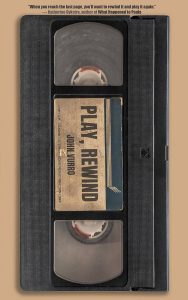
Play, Rewind by John Vurro

A Review by Jennifer Rivera

In Play, Rewind, John Vurro’s striking debut novel, readers are invited into the fragmented world of Wes, a twenty-six-year-old young man whose life has been reoriented around the slow unraveling of his mother’s mind. Vurro delicately balances narrative intimacy and structural sophistication, producing a work that is both emotionally affecting and formally ambitious. Set against the crumbling backdrop of a dying video rental store in Queens, New York, the novel is a meditation on memory, regret, identity, and the salvaging power of art.

Wes is introduced to us as a once-aspiring filmmaker now trapped in the liminal space between hope and responsibility. When his mother was diagnosed with dementia, he gave up his plans for film school to care for her full-time. The emotional cost of this decision, however loving, becomes the axis on which the entire novel turns. Wes is not simply a dutiful son; he is a young man increasingly defined by loss of future, of past, and of self. His mother, once his anchor, is now volatile and unrecognizable, her moods swinging sharply as her memory deteriorates.  Yet, Wes continues to maintain their home in its pre-diagnosis state, as if he can freeze time and prevent the erosion of her identity.

Vurro’s portrayal of dementia is remarkably grounded. Rather than romanticize the disease or turn it into a convenient metaphor, he presents it in all its harrowing mundanity: the constant repetition, the flashes of lucidity that only make the decline more painful, the emotional labor that never stops. Wes’s caretaking is both physically draining and spiritually exhausting. His only real support comes from Gloria, a compassionate and competent part-time nurse whose presence offers structure and a semblance of relief, even as the weight of the situation grows heavier.  She gently urges Wes to consider placing his mother in a home—an option he sees as both a betrayal and an impossibility, given their financial constraints.

A thread of mystery enters the novel when Wes discovers an unmarked videotape outside the store labeled “COPY DON’T WATCH. BE BACK SOON.”  The tape appears to be a simple home video of a couple’s Caribbean vacation, yet it becomes a powerful emotional and narrative anchor. What first seems incidental evolves into a deeply symbolic presence in the story: a glimpse into a life untouched by obligation, a visual embodiment of joy and freedom that stands in stark contrast to Wes’s own constrained existence. Vurro uses the footage not just as a clue, but as a catalyst. This artifact awakens something long dormant in Wes’s imagination and ultimately sets the story’s emotional and creative transformation into motion.

Wes’s emotional landscape becomes further complicated by the reappearance of Lola, a high school crush who disappeared without explanation just before graduation. She resurfaces as mysteriously as she vanished, offering neither clarity nor closure. Instead, she inserts herself into Wes’s life, posing as Joan, his mother’s long-deceased sister. Her role in the household becomes an unsettling performance, one that momentarily comforts his mother but ultimately disrupts the careful equilibrium Gloria has helped Wes maintain. Lola’s refusal to share her past and her tendency to sidestep caregiving boundaries create additional strain. Yet her presence also injects a kind of chaos that nudges Wes toward emotional risk—toward change.

Vurro uses Lola’s character as a reflection of Wes’s indecision and yearning.  Her mysterious past, her charm, and his intense emotions towards her all complicate the care ecosystem around Wes, forcing him to confront not only his mother’s deterioration but his loneliness.  Lola’s return and her impulsive efforts to help challenge Wes’s sense of control and his reluctance to look beyond the walls of his current life.  Lola’s presence also reintroduces the theme of escape. For Wes, the tape and Lola represent alternative lives: one imagined, one remembered, both infused with what-ifs.

The novel pivots when Wes decides to enter a film contest at the Manhattan Film School. With Lola’s help, he begins recording his mother’s daily life, interweaving this footage with the mysterious vacation video. The act of filmmaking becomes a vehicle for processing grief, confusion, and memory. In this way, Play, Rewind becomes not just a novel about film, but a novel structured like a film—editing together disparate pieces to create a coherent emotional narrative.

The documentary effort elicits a crucial confession from his mother: the truth about Wes’s father. Contrary to what Wes believed, his father never moved to Florida. Instead, after putting the family in danger due to gambling debts, his mother paid him to disappear. This revelation doesn’t just upend Wes’s understanding of his childhood; it exposes the fragility of the stories we tell ourselves to survive. Vurro handles this moment with quiet force, avoiding melodrama in favor of emotional authenticity.

Determined to uncover the truth, Wes tracks down the address on the lease his mother co-signed for his father. What he finds is both astonishing and painfully anticlimactic: his father, still living in New York, fails to recognize his grown son. In a further twist, Wes realizes the couple from the mysterious video—Greg and Sarah—are his father’s neighbors. The discovery is startling, but rather than wrap this coincidence in narrative certainty, he lets it remain ambiguous, inviting readers to consider whether fate, coincidence, or something more ethereal is at play.

As Wes grapples with these revelations, his caregiving responsibilities grow untenable. His mother injures Gloria, and Lola volunteers to stand in her place as caregiver.  After Lola impulsively takes his mother to a casino, resulting in a public disturbance and hospitalization, Wes is forced to confront the truth: he can no longer manage her care alone. In the novel’s most tender and mature turn, he makes the difficult decision to place his mother in a care facility. It’s a decision made not from abandonment, but from love—an act of courage that acknowledges both his mother’s safety and his own right to survive.

Vurro’s prose is unobtrusive but precise. The novel’s structure—layered with flashbacks, videotape footage, documentary scenes, and real-time struggles—mirrors Wes’s internal fragmentation and gradually reassembled self. The result is a story that feels deeply lived-in, like a memory being edited as it’s told.  What elevates Play, Rewind is Vurro’s stylistic control. His prose has clean, attentive, and unshowy qualities that allow the emotional weight of the story to build naturally. Dialogue is realistic and nuanced, often infused with a quiet ache. Cinematic imagery—unsurprisingly—is used with restraint, not flourish. The novel respects its characters enough not to impose meaning upon them. Instead, it invites the reader to sit in the discomfort of not knowing how long a loved one will remain recognizable, not knowing if a sacrifice will ever be rewarded, not knowing if art can truly redeem pain.

Ultimately, Play, Rewind is a novel about memory—how it fades, how it returns, and how it can be recorded, even remade, through the lens of love and art. Wes’s journey is not about reclaiming lost time, but about accepting what is and daring to hope for what might still be possible. In creating a film that blends fantasy and reality, Wes gives his mother and himself a kind of immortality.

This is a quietly powerful novel about letting go of the life you imagined in order to honor the one you’re living—and about the beauty that can emerge from the effort to preserve it.
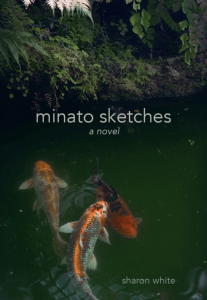



Minato Sketches by Sharon White

A Review by Mary Evangelisto Miller

When Gigi lands in Tokyo to begin teaching a summer-long art history seminar, she embarks on more than a professional appointment. Summer often serves as a bridge, especially for students and teachers, spanning the chasm between the end of one school year and the beginning of another. For Gigi, the summer represents even more: a rebirth. After a debilitating stroke, and years of rehabilitation, during which she was tasked with relearning how to perform basic functions—smiling, speaking, using utensils, word-finding—she is ready to reenter the world, outside the protective care of her family.

It is no accident that Tokyo is her destination. As a young student, Gigi’s period of study in Japan proved transformative, and an irresistible longing to return to that time while beginning the next phase of her life propels Gigi forward, despite her reservations. Trying life on her own, independent of her husband and sons, is the next step in her healing, as well as an attempt to reclaim something she lost inside her soul before the stroke caused her to lose her language. Postgirlhood, prestroke, Gigi lost sight of who she is beyond a wife and mother, and misses her fire, needing “this time to be a chance to reclaim some kind of wildness of spirit.”

As Gigi settles into what will be her life for the summer, she begins to reclaim herself through teaching, connecting with her students, and, in particular, through new friendships with colleagues—particularly Richard, a physics professor-turned-dance and yoga instructor. In her time off campus, Gigi explores various gardens and tends her own plants she has installed in her apartment. As the summer unfolds, her friendship with Richard becomes central to her life, as they spend many hours bonding while exploring Japanese gardens and parks together.

Recurring themes mirror the loss and renewal of Gigi’s health and vitality. Gigi frequently refers to her stroke as “lightning in her brain,” equating her medical emergency with a natural disaster. Likewise, the Japan of her youth has been transformed through the catastrophic earthquake and tsunami of March 11, 2011—a triple disaster involving a massive earthquake, devastating tsunamis, and the subsequent Fukushima Daiichi nuclear meltdown, leading to loss of life, displacement, and long-term environmental and social effects in the Tōhoku region. Tōhoku, too, is emerging from disaster; like Gigi herself, the Japan of her younger days is gone, but in the process of rising from the ashes. Still alive, but irrevocably changed.

In another metaphor for creating order from chaos, the work of Robert Smithson is mentioned throughout the novel. Smithson is best known for large-scale sculpture and land art; his focus was on transforming ruined or exhausted sites in nature into something new—much like post-lightning Gigi, or post-3/11 Japan. The wild boars that are thriving in the desiccated landscape in high-radiation zones in Sendai serve as another example of adaptation after a cataclysmic event. Gigi’s ongoing fascination, and eventual encounter, with these wild boars show her affinity for these creatures, which mirror her own strength and resilience.

Minato Sketches is a beautifully written novel. The fleshed-out descriptions of the gardens and flowers Gigi loves, as well as the still-recovering landscapes she visits, lend vitality to the text. The chapters are concise; like the still-recovering processes of Gigi’s brain, each chapter comprises sketches of time, rather than completed artworks. The voice and language are clear and simple. The multilayered structure of the novel creates interest throughout the novel as different elements of the story unfold. Through Gigi’s experiences, as well as the narrative, the reader learns details about Japanese culture and society that add heightened texture and meaning to Gigi’s experience.

In Japanese, Minato (港) means “harbor” or “port,” symbolizing safety, cultural exchange, and connection. The character 港 visually depicts water enclosed by structures, signifying a safe haven for ships. In Minato Sketches, for Gigi, the Tokyo summer is precisely that: a place of safety during her progressive healing; a place of exchange of what she was before the stroke for what she is becoming now; a place of new connections, not only with new people, but with Japan, as a metaphor for her own rebirth after disaster. As we follow Gigi on her journey, we are reminded of the fragility and power of change. What does not kill us may not necessarily make us stronger, but it will change us, and we must find a way to forge ahead.


Mary Evangelisto Miller is a freelance writer and editor based in Bucks County. She has been self-employed as a medical editor for 23 years. Mary holds a bachelor’s degree in Mass Communications and English from Temple University and a master’s degree in English and Publishing from Rosemont College.


Wisp

Bird


such a tight fist of letters

needing just a wisp of breath

to be heard


and when you see one,

at first

a brief wash of color,

music and motion

and then

in full focus

a wren

doing a fitful dance

on a porch railing

and singing

throat tilted up,

beak wide

you welcome

the thrust of energy

and the flow of liquid tones

yet also ponder

how ill-prepared

eyes, ears, mind and heart are

for the task

of taking it all in


but the bird

draws you back

and asks

that you unclench your mind

and relish,

while you can,

this puff of air,

this sketch

so deftly etched

and then,

just as swiftly,

swept away


Charlie McCurdy has been writing poetry for about 40 years. After graduating from Oberlin College with a double degree in English and Music, he taught high school English for about 10 years, practiced journalism for about 15 years as a music critic, reporter and editor for newspapers and magazines including the Philadelphia Inquirer and Chamber Music magazine, and worked in corporate communications for Merck & Co., Inc., Bristol Myers Squibb, Daiichi Sankyo, Inc., and Labcorp. He has lived in and near Philadelphia for 37 years with his wife, two daughters, one granddaughter and two dogs.


Schuylkill River Trail

To read “Schuylkill River Trail,” click HERE.


Anna Drasko is a writer from Pennsylvania. Their work appears or is forthcoming in Thimble Literary Magazine, San Pedro River Review, and elsewhere. They hold degrees from the University of Pennsylvania and Penn State. Find them on Instagram @annadrasko.


THE DOX THRASH MURAL*

To read “The Dox Thrash Mural,” click HERE.


Yvonne: Philadelphia born, raised, retired. First poetry editor at Ms. Some awards: NEA (poetry/1974/1984), Pushcart Prize (vol. 6), BRIO (1991), Leeway (fiction/2003). Recent print: A Black Philadelphia Reader (Penn State, 2024), The Hopkins Review (Summer 2023), POETRY (July/August 2022), Stronger Than Fear (CaveMoon, 2022). Website: www.iwilla.com


Making Humes Valley

After Harry Humes (1935-2025)


Write its history in teeth.

Make it part fox and songbird

settled on a sumac branch,


egg-stealing snout and a flash

of tail collaring the scree.

Shovel out the anthracite


and run hands on calloused cliffs,

spires of millet. Listen for

rock clicks. And don’t be afraid


to eat a little hill dirt.

Make it hard as tortoise shell

with the sure foot of a snake,


sacs of venom that vanish

into summer grass. Let it

open like an exit wound,


but give it the pleasing shape

of a peace sign. Fill its mouth

with a water break. Call it


Kashmir or Danube or Death

but don’t split the map in two.

Carve out its bottom for kings.


Make its memory hollow

like a broken milkweed pod

or the fleshy pink space that


hides within lungs. Then, dare it

to breathe, stand firm against wind,

all of the planet’s motion.


Robert Fillman is the author of The Melting Point (Broadstone, 2025), House Bird (Terrapin, 2022), and the chapbook November Weather Spell (Main Street Rag, 2019). Individual poems have appeared in  Poetry East, Salamander, Spoon River Poetry Review, Tar River Poetry, Verse Daily, and elsewhere. He is an assistant professor at Kutztown University in eastern Pennsylvania and the poetry editor at Pennsylvania English.


God Save the Human Cannonball

To read “God Save the Human Cannonball,” click HERE.


Marko Capoferri is a poet, musician, occasional journalist, and former conservation worker based in Missoula, Montana. He was born in Camden, NJ, raised in the Pine Barrens, and has since lived and worked in eight US states. His work can be found in The Shore, Painted Bride Quarterly, Anti-Heroin Chic, Ekphrastic Review, and elsewhere.


RUBBINGS FROM GRAVESTONES

& when

Huge oil portraits of my parents

hung on the dining room walls

as though we lived in a museum and people

paid good money to wander through

only no one ever came


& although

Each night after the maids in white uniforms

passed plates of uninspired food

us four kids sat eyes down

on our silent steaks and potatoes or pushed

the Friday fish around with silver forks


& because

We didn’t want to see those eyes

watching us from the walls, eyes

that could see the lies, saying our mother

made big breakfasts no need to bring

turkey sandwiches to school


& while

My mother licked the butter balls

ignoring her dinner, slurping her scotch

my father in a coat and tie carefully carved his meat

into perfect squares before taking a bite

willing her to sanity


Claire Scott is an award-winning poet who has received multiple Pushcart Prize nominations. Her work has appeared in the Atlanta Review, Bellevue Literary Review, New Ohio Review, and Healing Muse among other journals. Claire is the author of Waiting to be Called and Until I Couldn’t. She is the co-author of Unfolding in Light: A Sisters’ Journey in Photography and Poetry.


Flood Tide

She remembers watching the Rancocas rise

that year Belle slammed ashore

tearing siding and roof tiles from beach houses.


She recalls how the Mullica churned, a brown

foaming roil, sandy banks too weak to staunch

its uncharacteristic force.


How current unleashed itself from sluggish

shallow creekbeds. How the deadfall dams

re-routed its familiar flow.


The pine barrens sucked down eight

inches of rain in three hours and jetties

moved, the pilings cracked.


Mushrooms materialized on wooden stoops

and stair treads, roads dissolved,

the lights went out.


She and her mother sat at the table,

her mom’s face flickering in candle flame,

her dad standing at the bay window.


Loud. That’s how she remembers that

storm. And her father, young then, she recalls

his anxious observation of the creek—


calculating the crest, reckoning

the cost of abandonment vs. the risks

of stubbornness, attendant to the rain.


Ann E. Michael lives in Pennsylvania’s Lehigh Valley, where for many years she ran the writing center at DeSales University. Her latest poetry collection (2024) is Abundance/Diminishment. Her work has been appearing online and in print for many decades in numerous journals, anthologies, chapbooks, and two previous collections. She maintains a long-running blog at www.annemichael.blog


Perfect Mothers Bake Perfect Cakes

To celebrate our son’s first birthday, we settle on a London theme. By this, I mean that I settle on a London theme and my husband knows better than to object. I sketch a three-tiered layer cake, just like they do on The Great British Baking Show; it will be light blue fondant with Union Jack pennants and a fleet of double decker busses. The pièce de résistance will be the cake topper: a miniature crown molded from gold fondant and bedecked with edible pearls. This, mind you, makes perfect sense because our son was born within twenty four hours of Kate Middleton’s third baby and I had always intended to marry Prince William and my husband and I were very into watching The Crown on Netflix during the rare nights that we didn’t immediately fall to sleep after putting our newborn to bed.

###

“You have to try these,” I tell a fellow South Philly boy-mom who lives across the street.

“What are they?” she asks.

“Brownies!”

She’s skeptical. They don’t look like brownies, but that’s because they’re made entirely of dates, tahini, and cocoa powder. In my twenties, I made brownies with sugar and eggs and pumped them full of espresso powder to fuel the all-nighters that got me through grad school. But that was when I lived in London. That was when I could stay up to write as long as I wanted. That was before I had to wake up the next morning and be responsible for another human being.

“No sugar?” she asks.

“No sugar.” This is because now that I’m in my thirties and all-nighters are no longer possible, I’ve gotten into Vitamixing. First, smoothies. Then, baby food. Now, DIY almond milk and sugar-free approximations of the traditional brownie. “I’ve actually given up sugar,” I say. “And dairy too. And caffeine. And alcohol.”

“All at once?”

“Yes,” I inform her, basking in the glow of my moral superiority. “It’s my New Year’s resolution.”

“You’re going to murder someone,” she tells me. She is doing Dry January and suggests, ever so gently, to avoid triggering any homicidal tendencies on my part, that I should try eliminating one vice at a time. But I stand my ground. I will become vegan. I will lose weight. I will rearrange the furniture. I will reupholster the couch instead of working on my novel. I will renovate the kitchen. And I will bake our son the perfect birthday cake because it is through my cakes that I prove to the world–and to my child–that I am a good mother.

###

My son’s grandmothers both devoted their lives to the education of small children: my mother-in-law as a Kindergarten teacher, and my mother as the sort of stay-at-home mom/Sunday-school teacher/Girl Scout troop leader/4-H chaperone who could whip up a brand new batch of homemade Play-Doh in approximately thirty seconds.

I am good at Play-Doh–the homemade kind is just art with flour–but I do not particularly care for small children. I do not tolerate messes well. I prefer to bestow my educational zeal on young adults. College students present their own problems, but they are, even in their excuses, endlessly fascinating. Babies, on the other hand, are boring.

I make sure to document every not-boring thing my son does during the first year of his life–Held his head up! Rolled over! Sat on his own! Stood up!–but these accomplishments amount to little more than defying gravity. There is nothing stimulating here, nothing approximating fulfillment in my book. And yet, a good mother does not admit such things.

###

On paper, our son’s birthday cake will be the most beautiful cake in the world. On paper, I take pains to “enjoy every moment” of motherhood. On paper, our child is a little “bundle of joy.”

In reality, he comes to us blue, with the umbilical cord wrapped around his neck. After the NICU, he won’t latch properly. After the lactation consultant, he needs physical therapy. After the infant chiropractor, a tongue tie revision. When he finally sleeps, I hook up my breast pump and make my way back to Netflix, back to the Bake Off tent—as they call the show in the United Kingdom–where joy is manufactured and perfection is possible.

Physically speaking, Paul Hollywood is not my type. The fifty-nine-year-old co-host of The Great British Baking Show is short and stocky, with the puerile spiked hair of someone who refuses to acknowledge they’ve gone gray. But those bread-kneading biceps. Those baby-blue eyes. I loved a man with eyes like that when I moved to London for grad school. But again: that was before I got married. Before I had a child. Before I learned that life would occasionally require the outsourcing of my orgasms to bread-baking fantasies involving Paul Hollywood.

###

When our son is three months old, I think I’m having a heart attack so I drive myself to the ER. The doctor tells me I’m fine; I’ve simply pulled a muscle while lifting our baby to nurse.

At four months, the pediatrician tells us we can “extinguish” the night feeds but I can’t stop crying when we move our son out of the co-sleeper and into his own room. My husband gives me noise canceling headphones, turns on my favorite sitcom, reminds me that our child is literally four feet away. But four feet might as well be his freshman year of college, so I burst into tears all over again.

My mother-in-law comes to visit. She bakes casseroles. She does laundry. She slips into the nursery to hold our son when he cries. We’re meant to be sleep training. I am not kind about this fumbling of our plans. I have to take myself out to the front porch to calm down. I have to take the dog around the block. When neither of these things works, I order books–more books–that promise to preserve my sanity and get my baby to sleep and solve my diastasis recti by magically knitting my abdominals back together.

At six months, an editor I met on a press trip commissions me to profile a famous choreographer for her magazine. My heart leaps. My mother offers to babysit. I take my laptop straight to the coffee shop, having already conducted the necessary research during nap time. The words come slowly because I am out of practice but I am alive again, if only for a few hours. So alive, in fact, that I stick my foot in my mouth when I tell my stay-at-home-mother how happy I am to finally be going back to “work.”

It takes me several years before I can ask my husband, “Do you think I had postpartum depression?”

“Of course,” he says. “I thought you knew?”

But I didn’t know. I just baked cakes.

###

Between feeds, I teach myself how to make fondant with melted marshmallows and powdered sugar. I teach myself how to stack a three-tiered cake with wooden dowels and cardboard. At last, I decide to take my newly-acquired skills for a test drive. The result is not the elegant, three-tiered, astronomy-themed cake I had intended to make for my husband but more a deflated alien spaceship.

“It still tastes very good,” my husband tells me. “Don’t worry.”

I try not to cry.

“You’re right,” I tell him. “I’m being silly.” An alien space ship is at least astronomy-adjacent.

Still, I push the stroller to Home Depot. The internet tells me that masonry tools will get the frosted edges of my bakes nice and crisp. And a crisp edge with a 90-degree angle is what separates a good baker–a good mother–from a failure.

###

Here, in pictures, I am good. Here, over the years, my child is hiking, camping, playing T-ball, building sandcastles with his cousins, sitting atop his father’s shoulders to set a star atop the Christmas tree. Here are finger paints and homemade Halloween costumes and culturally enriching activities like painting en plein air along the Schuylkill.

But sometimes I am not good. Sometimes I am just too tired for watercolors along the Schuylkill: the bikes, the snacks, the paints, the paintbrushes, the mason jar full of water to clean them, and the paper towels needed to dry them. Sometimes I just wish my son would be quiet so that I can write.

###

The London cake is off to a much better start than the astronomy cake. But the crown I have sketched in my notebook refuses to materialize. Perhaps this is because I don’t want just any old crown. I want the crown from The Crown. But the crown from The Crown is made of gold. Mine is not. Mine collapses under its own weight.

It occurs to me that I could just top the cake with a candle in the shape of a number one from the Dollar Tree on Oregon Avenue, which is where I’ve bought the cake mix and all of the necessary frosting because I’m more concerned with how the cake looks than how it tastes. (Don’t tell Paul Hollywood.) But there is no artistry in this solution, no room for creativity.

Finally, inspiration strikes: I will top the cake with a fondant Paddington bear.

I very dutifully resisted the urge to spend £45 on a Paddington onesie at the Cath Kidston boutique the last time I was at Heathrow. Considering that I was seven months pregnant at the time and flying to attend the memorial service of my favorite professor, this took considerable restraint. But now, I shall reap my confectionary rewards.

I spend three days on Paddington, and for three days I am almost alive again: royal blue fondant for his coat; red for the hat; brown for his head and various appendages.

At the Michaels on Columbus Boulevard, I treat myself to an assortment of fondant tools. They look like something a dental hygienist might use: pokey things and pointy things and mirrored choppy things. One has a serrated triangle on the end and makes a perfect stitch-like effect on the edge of Paddington’s blue overcoat. Even though he ends up a bit lopsided and must be secured atop the cake with half a dozen toothpicks to keep him from plunging three stories to his death, my mother-in-law is astounded: You made that???

Yes. Yes, I did. I set the cake in the center of the dining room table, and the cousins and aunts and uncles and grandparents gather round. I am wearing the same preppy blue-and-white dress that I wore to my brother’s wedding and have dressed our son in a coordinating blue-and-white sailor suit. We manage to snap a few photos before he tosses off the matching hat. The stitch-like details on Paddington’s coat are so vivid that they even show up in the photos I post to Facebook, which I know because people have commented on them, and this confirms that I’m a good mother.

###

But everything is not perfect. Only later would I learn that anthropologists have a term for the process of becoming a mother: matrescence. Nobody ever uses this term, not even that favorite professor, who was, in fact, both an anthropologist and a mother. When she learned of my pregnancy, her only advice was to keep working so that I could afford childcare, lest I lose my “potential.” Even as I type “matrescence,” Microsoft Word runs a furry red caterpillar–a very hungry caterpillar?–beneath the word, urging me to consider a correctly-spelled alternative. Is this because motherhood is meant to come naturally? Automatically? Does the process of becoming a mother–of determining the sort of mother you’re meant to be–not even deserve a name?

###

At the end of the party, Paddington sits alone atop a small plate because no one actually likes to eat fondant, not even my two preteen nephews who usually eat anything.

“Where would you like me to put him?” my mother-in-law asks, cupping the bear like a sanctified communion wafer.

“You can just throw him out,” I tell her, switching the baby from one hip to the other.

“But you worked so hard!”

“It’s okay,” I tell her. “What am I going to do with a fondant bear?”

She offers to take it home and put in her freezer.

“I can shellac it,” she says.

And for a moment, this actually seems like a good idea: Paddington from our son’s first birthday, then the trash truck from his second. We’ll have to switch to individual cake pops for his third, because of the pandemic, and then we’ll overcompensate with mason jar cakes and a fleet of rented quadricycles on Boathouse Row for his fourth, but for his fifth birthday, I’ll bake a mermaid-themed sandcastle cake, complete with a beach of brown sugar, ice cream cone turrets, and handmade chocolate seashells. My mother will be so impressed that she’ll call the neighbors to come see.

But is this the sort of woman I want to be? Channeling my creative impulses into birthday cakes when, beyond the highly choreographed fantasies of the Bake Off tent, beneath the socially acceptable performance of motherhood, I actually care so little for baking that I use a boxed mix from the dollar store?

Poor Paddington with his perfect stitching deserves a more dignified fate than that. So, too, does my son. So, too, does his mother, this woman that I have become. And so, on the afternoon of his first birthday, I put him down for his nap. I sneak into the kitchen. I take Paddington from his solitary throne in the freezer and I throw the fondant bear into the trash.

Then, I write. I write in fits and starts. I write in the margins. I write in between the cakes over the years. And by the time my son turns six, I don’t care about anything being Pinterest-perfect anymore because I’ve gotten myself into a fully funded MFA program for creative writing. An ice cream sundae bar, I decide, will do the trick and my therapist is very proud of me.

For his seventh birthday, halfway through my degree, my son decides he wants a pirate ship. We scroll Pinterest together.

“That one’s perfect!” he declares, zooming in on a veritable flotilla created entirely from fondant. But then my son–who is brilliant and kind and endlessly creative–remembers what I’ve taught him.

“Actually, nothing is perfect. But could we make a kraken out of fondant? Like, a really big one?”

“Absolutely,” I tell him. And together, we make a complete mess of the kitchen: clouds of confectioners’ sugar coating all of our appliances, melted marshmallows congealing in the microwave, food coloring- blue, green, inky purple- staining both the countertop and our fingertips. The color scheme is “ocean” so anything goes. And when my son wants to add another layer of white chocolate pirate skulls to the base, I tell him to go for it. “But save one for the crown,” I suggest, because even the deadliest of beasts deserves to feel fancy.

And this crown materializes: yellow fondant with seven spikes and a pirate skull in the middle. We mold seaweed from green fondant, ocean waves from Dollar Tree frosting, sea shells from sea salt caramel flavored candy melts. And when we top the cake with a perfectly imperfect eight-tentacled kraken, I don’t even bother to post a picture on Facebook. I’d rather share that I’ve just published my first short story, and it’s been nominated for a Pushcart.


Kat Echevarría Richter is a fellow in the Creative Writing MFA program at Rutgers-Camden. Her work has appeared in Glamour, Glassworks, and Skirt and her essay “Becoming Boriqua” won first prize from LMNL Arts. Kat lives in South Philly with her partner, their child, and a neurotic but loveable rescue dog.