Coronation

Crows & their eyes’ starry glint,

brassy anklets of sparrows, ruby-crowned kinglets:

among these trees all limb & lung, each is a jewel


churning hours, draping Earth in necklaces of song

that rain onto my bed of ringlets

black as crows & their starry glint.


My dark volunteers decide where they belong.

Abiding by the current of these glossy rivulets,

I shrug at the slim rings crowning my head, fussy jewels


I swear stand on end when the crows arrive each dawn.

Breezing from the trees (those gem cabinets)

the crows nearly appear to wink—that starry, starry glint.


I toss them some peanuts on the roof and lawn,

willing our adjacent lives to better bisect,

hoping they’ve glimpsed in this gesture a jewel


of goodness. The human shock of my face gone

softer, daily, till in beaks of black intellect

the crows carry a kinship with my own starry glint.

All limb & lung, wing & song, each of us: jewels.


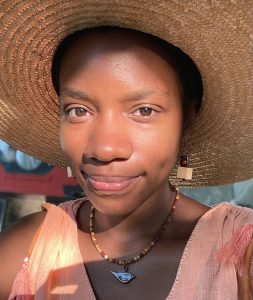
Basia Wilson is a poet with a BA in English from Temple University. A finalist for the 2022 Banyan Poetry Prize, Basia’s work has most recently been published in Voicemail Poems and bedfellows magazine. Selected for Moving Words 2023, her work will soon be adapted for animation in an international collaboration between writers, animators and filmmakers with ARTS By The People.
5 x 8

Take the afternoon train toward

forgetting.

Fill the saddlebags of your Harley.

Go in peace.


I will wait under the birch

for the owls to cry.


Hitchhike to Columbus.

Carry a calico bandana full of lightning.


I will remember the hedgerow,

the small silver trout,

the history of icicles,

the taste of juniper berries on your tongue.


Pack your trunk, take your pistol,

Measure the wingspan of a barnwood flag.


I carry a snail in my backpack.

He chases a grasshopper

under stones.


Heartsick, your highway

whispers ‘tomorrow, heart,

ache’. This is a film,

twice forgotten:

a spaghetti western,

this balloon lifting

you from sleep.


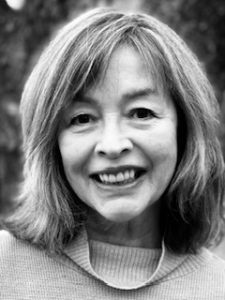
Pediatrician Kelley White has worked in inner-city Philadelphia and rural New Hampshire. Her poems have appeared in Exquisite Corpse, Rattle and JAMA. Her most recent chapbook is A Field Guide to Northern Tattoos (Main Street Rag Press.) She received a 2008 Pennsylvania Council on the Arts grant and is currently Poet in Residence at Drexel University College of Medicine. Her newest collection, NO.HOPE STREET has just been published by Kelsay Books.

Filling Up

On a winding road this side of South Mountain

which looms beside the less and less quiet valley,

we park the Jeep just past a roadside spring

that streams from a pipe fastened to a rock.

Such an insufficient description, I know,

but you don’t need to see it, just trust

that today as we lift empty plastic jugs from the back

and pop the caps to fill up on the free spring,

I’m stuck in time, or maybe just seemingly so

because nothing passes—not a car, a bike, or a breeze,

not a sound from the songbird likely stuck somewhere

deep in the somewhere trees erectly still on the mountain.

I’m bound by the thought of us here, somewhere

in the muck of life and all that’s falling

each day—each leaf, each dripping drop, each glimpse

of sunlight reflecting from the cascade of uncertain endings.

Someday I’ll ask where this went, where it fell or what it

fell into. But if I stay here, stuck, just one moment more,

I know I’ll find a way to slip this into my pocket,

zip us up, cap these jugs, preserve the roadside spring

that begs us to drink—drink from this leaky mountain,

as if we seek the answers or even know how to ask.


Wes Ward was born in Dover, Delaware, though roots tie him back to Chester County, Pennsylvania, where his dad was raised. Now a familiar stranger to Philadelphia, Wes lives a couple hours due West of Independence Hall and teaches high school English and college writing. He earned his Master’s of Arts in Writing from Johns Hopkins University.

Queen Anne’s Lace

To my mother, Elizabeth Worthington Shelly


A coarse scatter of gravelly buds

with a bare wire undercarriage,

a stem like baling twine,

and the aroma of last night’s dowsed fire.


No silky petals here:

you look like the doilies old ladies lay

on the heads and arms of chairs

to soak up sweat and body oil.


How cruel, they named you for a queen

when you were always a working class flower,

a Depression bloom.

There was never any luxury for you:

nobody took you into their garden

to cultivate or to coax.

You grew up in worn out fields,

in ditches along the sides of roads,

nurtured on rocks and exhaust fumes.


And that one purple dot in your center?

The one legend says is lacemaker’s blood?

That’s yours: shed along with your last tear

before you learned never to cry again

no matter how much it hurt.


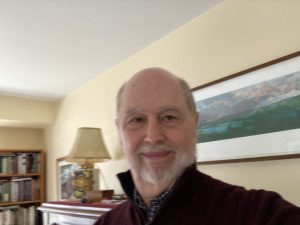
Steve Shelly lives in Devon, Pa. and has worked for many years as a psychotherapist. His poetry has appeared in a variety of publications including The Atlanta Review and Philadelphia Stories. He works as a Volunteer Guide at the Philadelphia Museum of Art.

Bic Breath

To view “Bic Breath,” by Jake Price, click HERE.


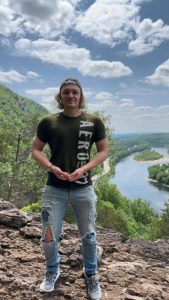
Jake Price is a sophomore student at Susquehanna University pursuing a degree in creative writing. He spends most of his time reading his work to his cat, Raven, who has yet to give him any feedback. Jake has an Instagram account where he posts his poetry, @‌nolenprice, that has amassed over 3100 followers as of writing this. His poetry has been published in Rivercraft Magazine, Poet Lore Magazine, and Sanctuary Magazine. His short fiction has also been published in Cream Scene Carnival and Querencia Press.

The Moon as an Engine of Burning

I don’t want to start with the moon

but it was gloomy outside

and there was a pale quivering light

that reflected from water

and silvered the tips of branches

leaving me little choice

even as I contemplated again

the traumatizing prospect of aging

even as I stood there on the renovated deck

considering whether to walk the avenues

in order to clear my head

or to return to my laptop

with all of the tasks that I was avoiding

and as I continued to kill time

and waste psychic energy

you appeared     backlit in the doorway

and as I watched you

the flames licked up from the bottom

of your dress and burned it away

your arms raising     and fire leaping the gap to me

and I was lost inside moonlight

inside unbreathable heat

I still remember that night after all this time

I still bear the scars

of that unexpected conflagration.


Paul Ilechko is British American poet and occasional songwriter who lives with his partner in Lambertville, NJ. His work has appeared in many journals, including The Night Heron Barks, Tampa Review, Iron Horse Literary Review, Sleet Magazine, and The Inflectionist Review. He has also published several chapbooks. 

In the Golden Hour, Cormorants

We first noticed the cormorant late afternoon,

the golden hour just before dusk,

black feathers and kinked neck,

a thin hooked bill, perched

on a piling facing the house as though

watching the oxygen tanks unloaded

from the back of a truck, the wheelchair

we carried up the front stairs.


The next day there were more,

diving deep beneath the docks, feeding

for hours before coming to rest

one after another on pilings

until every one was taken.

A silent chorus, in their black robes,

and as the time we’d been given

shortened to a few days they offered comfort,


a belief that as long as they stayed

she wouldn’t die, even as she refused

pudding, sweet tea, turned her face to the wall

as we moistened her lips with a wet cloth.

The last day was quiet, the water still

until her final breath when wind

suddenly kicked up. I watched

as they rose in unison, heading south

as though ushering her away.


I wished them safe harbor.

I wish them safe return.


Poet, teacher, and editor, Cheryl Baldi is the author of The Shapelessness of Water and a former Pennsylvania Poet Laureate. A finalist for the Robert Fraser Award for Poetry and the Francis Locke Memorial Award, she is widely published, most recently in ONE ART: a journal for poetry. She volunteers for the Bucks County Poet Laureate Program and the Arts and Cultural Council and lives in Doylestown, PA and along the coast in New Jersey.

The Reading – ONLINE BONUS

Editor’s Choice: 2023 Sandy Crimmins Poetry Contest


1979, after Carolyn Forché


You haven’t heard this one, but we were there. In the bright ugly room

behind a row of bald professors. It was April, and sticky. The plastic chairs

sucked at our thighs. Some dignitaries led her to the podium. She was just

a girl-poet, with her long blonde hair and flowy clothes, and all the easy

romance of being not too old but enough older than us. After the Chair

introduced her, she spoke in a voice so low we all leaned in. I was in his house.

His wife carried a tray of coffee and sugar. Some pipes clanked inside the walls.

Outside, through the open windows, frat boys were shouting. We were on

the inside now. We feared the colonel’s spoiled teenage children. The dog,

the American cop show. And— Don’t write about a pistol unless you intend

to use it, we knew at least this from our professors—the pistol on

the cushion by the colonel’s thigh. The poet’s words were candy tumbling

from a table; then, her voice dropped softer: our tongues on the dried peach

halves. Oh, I can tell you this now,

There is no other way to say this:


Metaphor is a tool of the wicked.

Metaphor presses against your skull, your nose squashed to the glass. The

window was never meant to open. The architects made it that way. On your side,

the Chair is paying attention. His nostril hair flutters with each bated exhalation.

The girl-poet will become famous. On the other side, the scene is vivid. An ear

unfurls in a glass of water. The ear is disconnected from the mind. On the glossy

tiled floor, a scattering of amputated ears “to the ground.” Life is a series

of amputations. You are mute as a nun in church. The girl beside you, who

cries easily about ideas, weeps with shame.

How can we go forward in this future? How can we go on?


Karen Rile is the author of Winter Music (Little, Brown), a novel set in Philadelphia, and numerous works of fiction and creative nonfiction. She teaches creative writing at the University of Pennsylvania and is the founding and chief editor of Cleaver Magazine.

Foxes & Hounds – ONLINE BONUS

Editor’s Choice: 2023 Sandy Crimmins Poetry Contest


In my pocket, the shudder of a newborn marsupial.

Along my back, a stampede


of tiny mammoths stomping through snowdrifts,

plummeting down a precipice.


Between our legs, a convergence of ladybugs

seeking out aphids,


reappearing each Spring as if by magic, as if drawn

by the pointillists.  In my eyes,


two black holes born to feast on scattered light,

to render it absent.


My foraging fingers rifle through the typewriter,

are robins shedding feathers


to feed them into keys, ripping out the ribbon

with derricked beaks, nesting


in flocks of silence.  My skull glows from within,

is bioluminescent, cradles


this thinking prisoner of uncertainties accrued,

my embattled mind


a zigzagging chase, both a pack of stubborn hounds

& the foxes it pursues.


Jonathan Greenhause’s first poetry collection, Cupping Our Palms (Meadowlark Press, 2022), was the winner of the 2022 Birdy Poetry Prize, and his poems have recently appeared or are forthcoming in Barrow Street, Bayou, The Fish Anthology, Michigan Quarterly Review, and Permafrost.

It’s Not True What They Say About Thunder – ONLINE BONUS

Editor’s Choice: 2023 Sandy Crimmins Poetry Contest


and lightning and how if you count the seconds

between the flash and the rumble, you can tell how close


the sky is to becoming a guillotine. I once saw lightning split

a tree trunk in half. Thunder didn’t follow for another ten


seconds. Sand can turn to glass. Did you know that? Each shard

settles at the base of my spine. What happens when they no longer


keep me fused together? If I stare out of a car window long enough

will my reflection disappear completely? Would you will it to happen?


Yesterday, they recorded upside-down lightning in a Kansas town

and it reminded me of a long-downed tree in the local cemetery—


how it looks like a hand getting ready to pluck the tombstone

straight from the ground. I can’t remember the etched name


in the stone but I remember thinking how I wished it was mine.

For the storm to make me an offering: Say, here I’m going to shelter you


for a while. It’s not true what they say about remembering. The lobes

could be ripped out electrical cords, cause a surge—unpower what


I should have forgotten: your birth year, how you smelled on a Tuesday

afternoon, the drawn-out agony. I was once told that thunder was just god


and the angels bowling. How I listened for the cheers after each strike

of a pin. I’m still counting the seconds between entering this world


and being taken out. What I mean to say is when the thunderclap

sends the windows singing, I want my end to be a white-hot echo.


Erica Abbott (she/her) is a Philadelphia-based poet and writer whose work has previously appeared or is forthcoming in Button Poetry, Midway Journal, Kissing Dynamite, The Broadkill Review, and other journals. She is the author of Self-Portrait as a Sinking Ship, is a Best of the Net nominee, and volunteers for Button Poetry, Write or Die, and Variant Literature.