In June

I’m often wrong about

the true nature of things.


A turtle turned out to be a rock,

a sleeping dog a rotten stump.


I wish the world could provide

all that my mind imagines


though, once, as I was walking

through Washington State Park,


I saw, wrapped around a patch

of willow beside a stream,


a band of brown cloth that I took

for debris from a recent flood.


Trash, I thought, until the form

animated, raised a narrow head


and, hissing. shot into the water

faster than my eyes could follow.


Afterwards, it was as though

the burning bush had gone silent.


Chris Bullard lives in Philadelphia, PA. In 2022, Main Street Rag published his poetry chapbook, Florida Man, and Moonstone Press published his poetry chapbook, The Rainclouds of y. Finishing Line Press published his chapbook, Lungs, in April and his work appeared in Keystone: Contemporary Poets on Pennsylvania, this May.


Astronomy

on our first date i’ll take you to

that field of carnations in wisborg

and tilt your fanged head

towards the unpolluted constellations:

look, there’s cygnus. and draco. and cassiopeia—

we’ll turn the color of elephants in the starlight

and earth will forget to turn

the same way it does during daylight savings.

i’ll carve you a vase the shape of a pomegranate

and fill it with dust from a blood moon;

you’ll talk about planets in retrograde,

neither of us knowing what that means.

we’ll fear the day much more than

garlic or silver or wood, all things that

maim but don’t kill.

every time you leave i’ll put away my telescope,

gaze at the five-pointed indent of your body

and wait for the sun to set again.


Jason Zhang is a Northeast Philadelphian whose hobbies include thrifting, open water swimming, and watching horror movies. His writing has been recognized by organizations including the Scholastic Awards, the New York Times, and Adroit. He is currently in his first year at Stanford University, where he plans to study Political Communication—and keep writing, of course.


Rideshare

The car is silver, not taxi yellow,

and nothing in nature could ever account

for the green of the driver’s hair.


It’s the color of money, she says. She says

sometimes her life can fold in like a purse,

but she always knows the price she’s paying.


She says her name is Faith, and she thinks

her mother meant it ironically,

but the karma seems to be working okay.


I could have been born a boy, she says,

or married one. Or both. I could

have become some kind of tycoon. Or worse.


I’m happy, she says, the way I am.

I know where I’ve been. I do not begrudge.

I know where I’m going. I am not driven.


George McDermott is a full-time writer and occasional teacher living in Florida with a Renaissance Woman and their remarkably literate Border Terrier. His poetry has appeared or is forthcoming in such journals as Harvard Review, Notre Dame Review, Chicago Quarterly Review, and Painted Bride Quarterly. His chapbook—Pictures, Some of Them Moving—won the Moonstone Chapbook Award. He is also co-author of What Went Right, a nonfiction book about the successes and missteps of public education in the United States.


Deliverance

Nine Months at Philly Parks and Rec: #1


They hand me forgotten dice

each a different shade of white —

a plastic snake who’s tail has been ripped off.

Can we glue it back together? they ask.

No, we have to bury it, I say.

Their toy from home with instructions

that no one else is to touch it but me.

Miss Holiday, look, they say.


Look

at this piece of paper —

a drawing of a broken heart.

It’s mine – earlier I stole her nose and

have yet to give it back.

Then another drawing of a whole heart after

I asked if she wanted my heart in pieces.

Look, Miss Holiday, they say.


Look at

my Lego spaceship,

what I can do on one leg,

at this bug, is it dead? Look

at how this hurts me!


I too still walk with cupped palms

outstretched, in search of a recipient

of my own salvaged shards.

I understand a plea

for deliverance.


And so when they offer, ask,

lay siege,

I accept.


Holiday Noel Campanella is a multi-disciplinary writer and artist from South Philadelphia. Her work has been published in numerous lit mags and journals, (Gigantic Sequins, San Pedro River Review, Pink Disco, Meow Meow Pow Pow) exhibited and sold nationally, (The Smithsonian Museum, Anthropologie, The Clay Studio) and collected in public and private collections (The Free Library of Philadelphia, Vanderbilt Libraries Special Collections). She has a BFA from the University of Pennsylvania and The Pennsylvania Academy of the Fine Arts in painting and creative writing. You can find out more at holidaynoelcampanella.com.


Last

I did the work your nervous fingers

were afraid to do


I pulled the razor gently

over the turns in your face –


a landscape I have traced since birth –

I fill a wooden cigar box full of lasts


last laugh, last drive with you drumming the dash

last song deejayed in the kitchen with the broken cabinets


your skin – once baby soft – now covered

in blonde stubble, smothered in shaving cream


I pulled the razor down over the jawbone – widening

as the years stretched you towards manhood


last dirty sock strewn in the front hall, last homework assignment not yet done

last voicemail, last text


I pulled the razor down your trembling neck

Adam’s apple rising – not sure if it could trust me


last sticky bag of Swedish fish tossed just shy of your trash can

the last thing I said


I finished with the thin space

above your top lip


a space so intimately yours

I wondered even then


if this would be the last time

I touch you


Colleen Ovelman is an editor and poet, originally from West Chester, Pennsylvania, now living in Vermont. While much of her work and publications are focused on evidence-based medicine, her creative work has previously appeared in the Best of the Burlington Writer’s Workshop, the Grand Exit podcast, and in Vermont Stage’s Winter Tales. She is currently working on a collection of poems, a history of mending, which explores living with grief in the aftermath of her teenage son’s death.


Insomnia, Part XXII

Within the salon’s dark cough, beauticians

glue fingernails to their anchorage.

Enslavement to labor is nothing like sleep.

Awake they wait for papers whose likelihood

is quantum mechanical. They consume, pay

taxes on tobacco and tea, and move through

a city as though stickless in a kennel

of unfamiliar dogs. Where they were born

they welcomed eggs without salmonella.

Extractive industry propelled a century

of blackened air. At night they could feel

atmospheric mud and the breath of siblings.

And into the night they would evacuate

to flee the earth’s hand-wringing. Here, they

subsist on a translated diet. They must train

the tongue backward and learn to swim

through natives’ suspicion. Headlong, they plunge

into the mainstream with so much fervor, so little rest.


Alan Elyshevitz retired as an assistant professor of English from the Community College of Philadelphia. He is the author of a collection of stories, The Widows and Orphans Fund (SFA Press), a poetry collection, Generous Peril (Cyberwit), and five poetry chapbooks. Winner of the James Hearst Poetry Prize from North American Review, he is a two-time recipient of a fellowship in fiction writing from the Pennsylvania Council on the Arts.


A Photo of my Grandfather (Sumter, SC circa 1928)

To read “A Photo of my Grandfather (Sumter, SC circa 1928),” click HERE.


Darryl Holmes received his MFA from Fairleigh Dickinson University where he also served as an editorial reader for “The Literary Review,” the university’s international journal of contemporary writing.  In the past few years his poems have appeared in Water-Stone Review, New York Quarterly, African American Review, Obsidian, River Heron Review, Kind Writers Magazine, Jelly Bucket, and Toho Journal. His first book “Wings Will Not Be Broken,” was published by Third World Press in Chicago.  He lives in NJ with his wife and youngest son who attends college in PA.  


Infinity curve, with cheesesteak

My brother looks me in the eye when we

talk – always. Even driving through Philly

at rush hour after the airport. He drives

with his left knee, both hands going up

with questions, out for emphasis, pointing

at landmarks – like the cheesesteak

place we passed at 70 miles an hour,

the c and the e in the neon sign dark

because, bullets. He plays drums at Temple

and works with street kids and stuffs himself

with all the life he can find. The sketchier,

the better, he says. He’s still going on about

cheesesteaks, wants me to know how good

food works. If you’re not running scared

to the counter and back to your car, you’re

eating average at best. I’ll take my chances.

I’m not here forever. Have you called mom?

He means he won’t live in Philly for long

but suddenly my stomach feels him gone,

sees my own hands white knuckling

the wheel, turning down the safest streets

with a broken heart and a hungry mouth

that wants another hundred miles of American

cheese and sautéed onions, driving so fast

you’d think God was tapping his foot, talking

about everything out loud as if our lives

depended on it, because they did.


Stacey Forbes is the author of Little Thistles, a poetry chapbook published by Finishing Line Press as the winner of their 2023 New Women’s Voices competition. Stacey’s work appears in some of the publications she loves, including Beloit Poetry Journal, New Ohio Review, Terrain.org, and Split Rock Review. Born in Pennsylvania, Stacey now lives and writes in Tucson, Arizona.


Divine Property: Tin Cup

I watched the blind beggar drag his body

into the shadow of Broad and Samson,
his hands like ash, his face half-covered

by an old hat he treats like an heirloom.

His cup was there, waiting like an open mouth,

the faint sound of coins bouncing against

its tin skin, each ping like a cracked bell

calling for something bigger.

He could tell a nickel from a dime by the way it settled,
its spinning stopped cold, and he must have felt
the difference between mercy and mockery—
the penny tossed by a man with rings on all his fingers,
the same man who spat once and crossed the street.
And the sign beside him, “Love Your Neighbor,”
written in some shaking hand, curling at the edges,
greasy with fingerprints by a friend in exile
bent away and ashamed of this kingdom.

I think about the weight of his bag, the bottle tucked
under his coat, warm against his ribs—his only comfort—
and I wonder about the composer of that sign, if he believed it,
if he too sat here once, holding out his hands.
He knows the sound of justice, the ache of an empty cup,
the slow, careful way hope folds itself into a corner
and waits for someone who knows its name.

And I want to ask him if he remembers
a song or a prayer, or if he only listens now
to the shuffle of shoes, the endless clicking
of heels on pavement, the city moving past him,
never stopping. Would he recognize my breath
if I knelt and dropped a quarter wrapped in a twenty
or would I become just another sound,
another dull thud in the cup’s wide-open mouth?


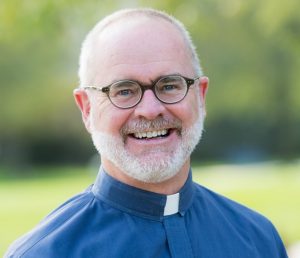
Tim Gavin is an Episcopal priest. In addition to his most recent publication, A Radical Beginning (Olympia Publishers, 2023), he is the author of Lyrics from the Central Plateau, a chapbook of poems released by Prolific Press in November 2018. His articles, essays, and poems have appeared in The Anglican Theological Review, Barrow Street Review, Blue Heron Review, Blue Mountain Review, Cape Rock, Chiron Review, The Cresset, Grow Christians, Digital Papercut, Evening Street Review, Library Journal, Magma, Poetry Quarterly, Poetry South, Poetry Super Highway, and Spectrum. He lives with his wife, Joyce, in Newtown Square.


For the Bride in my DNA

Village shuttered against night, clay stove fired up, the kettle steaming

in the damp. Her position set, the old Dutch-German requires it, a cook

to bank the fires to prepare the meals. His bed? She has her own, a right

to refuse the man; she made him sign his mark upon the deed she’s folded up,

squared in her belongings, a quilt she patched with her mother, a bronze knife,

a single coin to pay her funeral. The bride could be called young in polite nations,

here she is the cook, a lover if she permits it. There is no church, no dowry,

not even a dress beyond what she made on her last name day, stitched like her

comfort depended on it, the dress, a sturdy enough coat against cold, rain,

the haymaking weather she will cook in, every day, for the rest of her days,

with a man who agreed to pay her, shelter her, and fuck her with child, in her

own time, or his own time, should he drink or take to anger, as men do.

She is given flowers to cover her from evil, a bit of dirt from her father’s house,

a bit of ash from her mother’s hearth. She doesn’t believe evil is darkness,

she understands darkness divides evil into shadow, nothing can be trusted

with the eye. When the old man picks her up he whispers, I’ll keep demon’s fingers

from your ankles, and carries her into the house, and puts her down

like a basket of beets. He salts the stoop, strikes candles against the known.

They eat a stew with bread. He drinks to shatter her place. She hears the crack

of the whisky cask and tumbles into a well of worry. He visits her in those first hours

of darkness, the journey hardly off her, to keep you safe from it, from the evil 

that would take you right outside the door. She knows she has no choice

in the matter, she’s  heard her mother’s bed clatter;  the demon is in the gaps

between spirit and man, how often he lifts it to his lip, how often he puts it away.


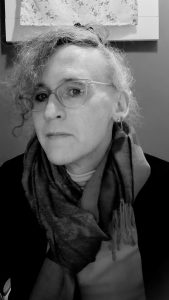
Cassandra Whitaker (she/they) is trans writer living in rural Virginia. Whit’s work has been published in Michigan Quarterly Review, Conjunctions, The Mississippi Review, Lamba Literary Review and other places. They are a member of the National Book Critics Circle and an educator. Wolf Devouring A Wolf Devouring A Wolf is forthcoming from Jackleg Press in 2025. wolfs-den.page