Minato Sketches – First Place

1.

She kept reading about how all the paper houses had burned. But as she came down out of the clouds, she saw shiny fields, wet with a sheen of green water and the spikey hills she remembered. The villages tucked into crevices between the islands of trees and rocks and fields. There were certainly paper houses hidden along the shining river. And more were folded in the curves and lumps of the hills. Long white birds announced their presence with their silence and the squat bodies of cormorants raced down the dark rivers once she got to the city. Everything was different. The last few years replaced with concrete that somehow seemed more alive than she remembered. So the woman who told her about the fires was right. The houses had vanished. In the morning she watched as armies of pedestrians marched to work. Their faces placid with sleep. One eyebrow raised here, another foot placed there. Such precision and pizazz. Every now and then someone would break rank and get a coffee at one of the cafes, mildly folding and unfolding a paper. Picking a white cup off a table and then putting it down.

2.

She ended up on a street with noodle stalls. None of them had any faith. She knew, after all, that they had to kill Jesus for him to be a savior. Military men were at every corner. And the large blue fish in tanks displayed along the walls slept. She could see them breathing in the dusk of their containers. Men in white shirts and black pants jostled against each other, banging their brief cases on their thighs. Everything was lit with a burning core. These men had been at work forever. Toting their bags from home to trains to the office to the narrow streets where the food was displayed on plastic cards or in bowls with plastic wrap. Old women beckoned costumers in at the doors. Huge signs with beautiful letters hung from every open window. So many drunk men rubbing their bellies, dancing in knots close to each other just about to fight. No English here, one sign said. Inside the stall it was quiet. A cook cocked his head and looked away. It was cool, so cool she pulled her sweater closer. She’d left two grown boys and a husband in a country far away, governed by an idiot in a red coat. Everything was alive around her and no one was quiet.

3.

Her new boss said I’m part Cherokee and part Quebecois. I have great friends all over the world, some from my youth hanging out at Johnson Pond. I have many more friends than you do and have held important positions. I’m a denizen of this place, a wow guy, why do you think I got this job? Look at my desk, my legions of pictures of families close to me, for sure I’m close to my brother and sister, too. We get together every year in Maine. I’ve lived most of my life away, but you know Maine is certainly what I call home. An old house on the green, the view of the ocean from the porch, the sound of gulls in the morning, the children skating on the pond in winter, the smell of woodsmoke. My history goes like this: I, like you, have moved from institution to institution always here, mostly here, but bigwig positions, nothing less. Have you had a stroke, he asked, I know I may have seen that in your documents. Are you sure you haven’t had a stroke? She adjusted her smile and said, it was a mild one, a mild one. I have no visible residue. But she knew residue was not the right word. Visible signposts, perhaps, a certain look, the way her family inserted one word or two when they had a chance, the way her little dog looked at her with distrust. It all got to be too much. That country so far away, their loving hands guiding her down stairs, past beggars in the street and gangs of motorcycle thugs prowling the boulevards where they lived. They went to a place in the north one winter soon after her stroke and stayed in an inn where the sheets were very white and they left chocolate on your bed at night. So sweet. They ate in the dining room and she brought her little white dog with her. The dog slept under the table and she could see other holidaymakers snatching looks at her from their beautifully set tables. There were people singing in another room and lights twinkling in the trees outside. Her husband and sons were happy, skiing during the day, and she could sit on the little porch in the sun with her white dog and think about nothing, nothing at all. There was no struggle to find any words. She was in the first months of her therapy and it was difficult to say anything. She could hardly smile. Don’t worry darling, her husband said, we’ll get you back to normal in no time and she would shake her head. She knew there was no normal around the corner. Her therapist had her draw a clock and she knew from her face, even if she said that’s great Gigi, that’s great, that she had somehow gotten it wrong, terribly wrong. She studied flashcards and did homework for what felt like hours. She was instructed to substitute one word for another, but she’d never been much of a poet and isn’t that what they did? She used to love to tell stories and she could see the painful look on her younger son’s face when they were all silent at the dinner table, her boys back from one college or another. One job or another and it was her husband, who used to be the quiet one, who carried the conversation like a suitcase.
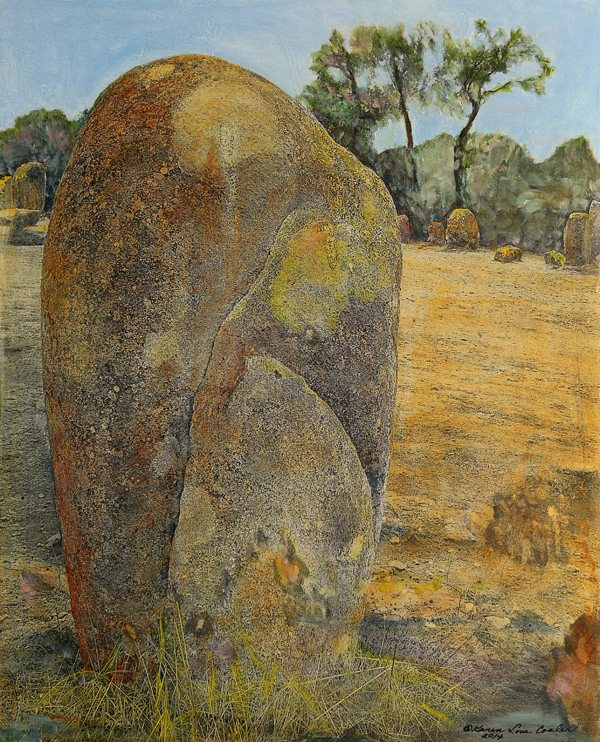
2_Karen_Love_Cooler_Menhirs_of_Alentejo_Standing_Tall
Menhirs of Alentejo: Standing Tall by Karen Love Cooler

4.

She had days before the program started so she went to a garden. She had admired this garden in books for years. When she was in this country years ago she was more interested in the mechanics of love than gardens. A brief affair, a few weeks of doing nothing but fucking on the floor in a narrow apartment where everything was miniature. It took her weeks to realize she wasn’t in love at all, just enamored of the idea. It was so far away, so far away from the kind of life she normally lived. And she loved the burning bite of sake and how it made her feel. How loved he made her feel, split off from the self she thought she knew, even if she didn’t know what she was capable of doing. She didn’t know that later when she had her stroke, years later, she wouldn’t know who she was at all and the sorting chambers of her brain would disintegrate so she couldn’t even talk to her little dog. Her little dog who she sometimes thought she loved above all else, her little dog with the pure white paws.

It was a garden of Waka poetry. The paths circled the pond in the middle of the garden like a magic incantation. Each viewing spot was a bell. A way to inspire memory. A key to the locked room where the words lived. Precious Seaweed Shore. Her days at the Cape with her mother and father and her brothers and sisters. The days burning to a crisp on the sand, cold as hell in the water. Those hours playing in the brook that went down to the sea, the horseshoe crabs moving so slowly along the bottom, waving their blunt spears back and forth. Her brothers stoning the rabbit to death one day when they went to visit cousins two towns away.

Ebb Tide Harbor, her life now.

It took her months before she could draw the clock on the blank piece of paper correctly. Now she watched a man measure bamboo stakes precisely and then saw them off and then hammer them with a wooden mallet into the ground along the edge of the mossy verge of the lake. He measured three times and then cut. She watched him happily. She was definitely happy, sitting on the wooden bench in the old garden. Very old, she knew, early 1700s. Two of the ponds were gone now, but the impression of the water on the surface of the earth remained.

5.

She wanted a resurrection. She knew that was blasphemous to want to so much. She wanted to be struck new with life. Instead God sent her lightening in her brain. And even if the doctors kept saying she’d be fine, she didn’t think this state was fine. She was such a talker. She could talk the ear off anyone, couldn’t she? Her sons knew that. And as she traveled more and more with her husband and they could do anything they wanted, she had so many stories to tell.

When her mother got sick it was up to them to take care of her, first in her older boy’s room and then in the facility down the road. It was a place with trees around it. The only place in miles with a grove of trees. Her mother didn’t care at that point that the two rooms looked out at trees, but she did.

It just seemed too much some times. The world was crumbling at the edges. A tyrant had taken over the country and the government was in shambles and then her mother started to say less and less. A kind of imitation of Gigi’s stroke, but much worse. She wouldn’t come back from this descent into silence.

She brought her meat sauce in a silver thermos. Morsels of chicken in foil. Beautiful sweet ripe clementines. Armfuls of farmer’s market flowers. Her mother stopped eating, her mother stopped moving, her mother stopped doing anything at all. And what was there to do? Her mother didn’t remember the soap operas she’d spent her life watching or the news at 6:30 or anything really. She was afraid she would forget who her daughter was. But she didn’t. Her sister came and stayed with her those last months. Her mother took forever to die. She’s just doing it on her own time, the kind nurse with the polished copper skin and tiny eyes told her. The books can only tell you the average time. The average time was two weeks, her mother wanted ten months and she took it.

6.

She’d had a bitter fight with him before she left. Her husband said, “I sacrificed all my waking hours to your rehabilitation and this is what you want to do now that I’ve got you back?”

“I was still myself, when you thought I wasn’t here,” she said. “I was still myself all those hours when you were away. I was with the boys in my heart, wasn’t I? I fought hard to get back to what you thought you wanted me to be.”

But it was all so dramatic, she thought. The simple thing was there were two of her now. The woman he’d loved for so many years and the one who went away. Went away in her head, all the words mismatched, unavailable for the moment. Not useful.

“You’re not the same,” he said, “not the same at all if you keep this cockamamie idea in your head and leave us again.”

“I can’t believe you said cockamamie,” she said and then they started to laugh. Everything was so ridiculous after all. There was the tyrant as president, the marches in the street, people with different kinds of hats parading in every town, marching and chanting. Flags waving on every corner. The terrifying blasts in even places you’d think would be safe. Knife attacks on subways. It was a relief to be somewhere like where she was then. Military men, and sometimes women, stationed at subways and street corners and outside of train stations to guide your way. The soft patter of rain, now that the monsoon season was warming up. She was not in the same world, but it didn’t matter. No one knew who she was before and she’d gotten the job on her own without the help of her husband or sons or even her little white dog, who she missed terribly.


She’d taken the train to a part of the city with twenty temples. Arched wooden temples with deities who might be sympathetic to her. It was kind of Zen to walk slowly around the village on her own through the vast cemeteries and narrow streets that were spared war and fire and bombing. The hydrangea were in bloom. Delicate lace bright blue like the sky. She met a girl with an owl. A pet owl, three months old. A baby, the girl told her. For a few yen, she could pet it. But it was enough to look at the owl as the bird swiveled her head back and forth. The soft whirl of spotted caramel feathers around her face. The owl’s deep black eyes shining as she looked into them and the owl didn’t flinch. The bird was perfectly calm. There was a world there that was very different from the one she’d fled. Serene, astonishing, filled with peace.

7.

She talked to a man at the faculty meeting who told her she should get a car, borrow someone’s to go to the big international store at the edge of the city. She could get chairs there, you could get anything really. It was stupid to take a train or a bus there, it didn’t make sense. After all what were cars for, if not to transport people to places where they could buy things, he laughed. He was thin and wore a white tunic. He had beads around his neck and his hair was as white as his clothes. Everything about him was impermanent, a little foggy. She could hardly hear him when he spoke. I used to teach physics, but now I teach music and yoga. Like the music of the spheres, she said, so that makes sense. He leaned in close to her, yes. The room was filled with men. There were hardly any women. She followed a man with an umbrella out of the building to an annex across the narrow street up the elevator. Are you one of the faculty she asked, or a parent and he said quickly, I’m the CFO. You’re a bigwig, then, she said. When the door opened he vanished down a corridor and shut the door.

A woman in the business office opened a brown packet filled with the first edition of her pay and fanned the money out on the desk in front of her. The solemn faces of someone famous in this country glared at her from the surface of the gray desk. There were so many shades of gray in the city.


She was making a garden on her balcony. It was just big enough for several small pots and it looked out at the canals. Someone had planted a spring garden along the paved walkway that ran along the bank. She was on an island of concrete in the concrete city. One man at the meeting told her during the last earthquake everything swayed and then was still. He likes to wear women’s clothes, another man told her.

8.

At one of the temples she visited she put coins at the foot of several minor gods who wore pink caps. They were standing guard along the fence to the temple near their leader, a much larger statue with a pink apron around his neck. There were crows the size of eagles carrying pieces of toast and little birds who flew through the towering trees faster than she could imagine. She missed her husband. He would have laughed at the pink hats. He was pretty irreverent about everything. A woman was pushing a cart filled with willow brooms and wooden buckets marked with black calligraphy. For holy water, she thought. Bouquets of fading flowers defaced the graves. Why didn’t someone take them away once they started dying? Bundles of wires crisscrossed the sky above her head as she walked into a tiny alley where they were selling juice and puffy buns with cream. She hadn’t been hungry in such a long time, but the buns were soft and warm in her mouth. It was a relief to be alone. She didn’t have to search for the words she wanted, she could let whatever came to the surface be what she wanted to say. Penguin. Pigeon. Parrot.

9.

Men with white gloves drove the cabs in the city. The seats covered with white lace. The white ghosts followed her when she went to the 100 yen store where the checkout person, a lively woman, told her there were so many foreigners in the neighborhood, or took the little bus to the hills north of where she was living. When she was watching her mother die all those months, her little white dog came with her. She waited for morsels of food her mother dropped on the rug or the crumbs from the tiny pieces of bread her mother ate. One day her dog noticed something on the ceiling. Her son thought it was angels. The angels come to lead her mother to heaven. She laughed, “Really” she said. “I didn’t think you believed in any of that stuff.”

“Really mom,” he said, laughing, “look at the way Tinker’s acting.”

She was acting strange circling her mother’s hospital bed, sniffing under the covers, whining at the ceiling. It was comforting in a way that angels were there to help her mother, when no one had been around when Gigi’d had her stroke. She was making lunch, something heated up in a pan. A strange thing to do, but there it was. Lunch was in her hand, she was walking across the kitchen, her beautiful white kitchen with jars arranged on the shelves, and the shining silver refrigerator, and then she fell. Lightning and then nothing. When she could see again she dragged herself across the kitchen floor to the hallway and then to the living room. Her phone was on a table in the immaculate room. It took her hours to reach her phone and when she got through to her husband all she could do was make a noise, a simple noise that she thought sounded like help me, but her husband said much later, months later, was more like a croak.

10.

It was hard to go a day even so far away from where most of her life had been without her mother appearing in some way before her eyes. She’d been persistently haunting her for her whole life. A woman who wanted perfection in everyone but herself. Gigi took the little bus to hills north of where her apartment was in the largest city in the world. The librarian at the university had told her about a museum with a small, perfect garden. She walked aimlessly in the direction of where she thought the museum was past women with their perfect faces, their gloved hands clutching bags from expensive stores. Each one accompanied by her mother. A woman who was an older version of themselves, but just as perfectly dressed in shades of cream, or gray or delicate floral.

On the bus, she’d met a woman who told her how to get to the museum. I’m going that way, I’ll show you, she said. Her English was impeccable. They walked quickly along the wide boulevard. “And you live in the dormitory of the university?” the woman asked.

“No,” Gigi laughed. “I live near the bay, in an apartment.”

“How nice,” she said. “But you’re very brave to spend the summer in Tokyo.”

“The heat?”

“Yes,” she said. “The heat, the humidity. It’s really quite terrible.”

“What do you do?” She asked the woman, who was wearing navy. Her short stylish hair framing her face.

“I’m a guide,” she said. And she laughed. “I’ll leave you here, I’m going to the market. Have a wonderful summer. You should really stop at the market after the museum. It’s my favorite museum.”

She wondered if everything in her life was an echo of her mother and if, since her mother’s death, everything was a shadow of that same echo. In the museum she spent an hour studying many hanging paper scrolls with squares of poetry framed by paper, adorned with gold flecks. Saturated with the color of the sky or the moon or the sun. In another room there were tea bowls with names, famous tea bowls celebrated for their misshapen beauty.

There was a Buddha in the garden sitting quietly when everyone else was circling the garden, taking pictures. The Buddha sat on the edge of the flowing stream, before it cascaded to the pond where two turtles overlapped on a rock. Stretching their green streaked necks out, sunning. It was much cooler in the garden, she wished she’d worn a sweater.

11.

She met her new boss again in the street when she was looking for lunch. He was pushing a bike. A young woman, very beautiful, was trailing behind.

“How are you?” She asked.

“Great. I’m going to work out and she’s going home. You know they’re here to review me. I thought I’d look for a putter. When those meetings are taking place on Friday, I’ll be playing golf with Fred Olson. But I need a golden putter. When I played with Tony Mashimito he had the putter to end all putters and he beat me like that. He gave a ton of money to the school. I want to be ready this time. I’ve got to step up my game.”

There were children all around them as the young woman smiled shyly. She was dressed in a silky flowered frock. He was in a polo shirt and shorts. His bike was black. His teeth seemed to be broken, or cut off at the ends. Such an unfortunate mouth. She couldn’t imagine him kissing the young woman who walked behind as he pushed the bike. But you never knew about these things.

12.

She knew her mother’s body too well after those months taking care of her. She would guide her into the shower, turn the water on and then hose her off with the handheld shower. Her mother’s skin was still firm. The pounds she’d accumulated over all those years of life gleaming on her bones. After those months in the facility when she refused to eat, things changed.


She wakes to bright light, almost burning white here, very early in the morning. At the Cape when she was young, not so young, just after she graduated from college, the first time she  had a hard time calling up words, she would visit her aunt and uncle and stay in a bedroom in the basement. Right on a marsh. It was the light then that called her to the ocean. A brilliant burning on the waves, the salt spray on her tongue in the morning. A kind of crystalline definition of the birth of the day.

The city presses down around her after her days in the foreign country. The ambulances politely calling out to pedestrians to please move away from the vehicle, the women in the department store showing her all the attributes of the pillow she wants to buy anyway. They instruct her to try it out, her head on a piece of gauze covering the pillow, her feet placed on a sheet of plastic at the foot of the bed. When the transaction is finished the two women dressed smartly in tailored clothes, like a uniform, bow and thank her over and over again.


It’s the time of the year when trains are delayed in the city. The electric screens in the subway announce passenger injury several times a day. Or antelope on the tracks. Gigi thinks it’s a problem with translation. Could there really be antelope in this country? The term passenger injury means someone has jumped. It’s just a euphemism for death, several people at the faculty meeting told her. It’s a bad time of year for that. The raining season coming up, the brutality of the spring. Everything blossoming. New life. She’d read in the news that pigeons had been arrested for carrying little backpacks with pills sewn into the fabric. The backpacks were miniature and fashioned to look like their feathers. The pigeons didn’t know they were drug mules. They just loved to fly.

13.

In a prefecture north of the city there were radioactive wild boars. Thousands of animals with blunt noses and fierce eyes. Hundreds of hunters had tracked them down and killed them but not enough to clear the cities. She was curious. Her days in the sparkling city were lining up into something she couldn’t define. It was the first day of classes. Someone was pounding on the floor above her apartment, shaking the ceiling.

A friend had lost her husband once in in the aftermath of an earthquake. She was visiting a place where they were building a beautiful resort on the sea. Her two girls were with her. She and her husband had gone to take a look at the resort. The girl’s godfather was part owner. The girls were up in the hills with a friend exploring. When the tsunami hit, their parents had to run for dry land and their father spotted the skeleton of a building. He led a group of people wearing only their bathing suits to the top floor. It was too much for him and he died there, already prone to a weak heart. Her friend had to cover him with someone’s flowered wrap and leave him there while she searched for her daughters. She thought she’d lost her family to the water.

“I didn’t know if they were alive,” she told her. “Until I heard from a friend who I met days later that the girls were with another friend, safe and well in another part of the island. It changed everything for me. And then we all went back to the place where Andrew died and brought his body into town.”

14.

One of her students, a solemn boy from India, told her he almost died climbing the sacred mountain. You were supposed to be able to see it from the city, a perfectly shaped cone with snow on the top. But she’d been lost in the concrete caverns for days now and couldn’t understand how you could see the mountain from the city. It rose up, she knew, from the plains below. A stark reminder of the majesty of geography.

Her student, Goreesh, was climbing the mountain with six friends. They were ill equipped and cold by the time they got to the shoulder of the mountain. There was a hut where they paid a huge amount to sleep on hard pillows and wrapped themselves in one thin blanket. He was not feeling well. Maybe it was the altitude, he thought, and his friends wanted to give up. But he went ahead in time to see the sunrise. He was so tired, he told her, that he slipped at the edge of a ravine and was almost never heard from again. And he was so young. His mother would have been bereft and his friends very unhappy, but he caught himself and they all went on to reach the top. It took them 18 hours to climb the mountain.


She was thinking perhaps she should tell the man she’d met at the faculty meeting that she would take him up on his offer to find a car. She wanted to go somewhere, anywhere out of the city. Was there something wrong with that? She was thinking she wanted to go to the prefecture with the wild boars. There were deer there and hawks and other animals gathered in a place with lots of grain and fruit trees and tender shoots to eat. A ripening away from human habitation. She thought it would be interesting to catch a glimpse of that. The authorities were trying to convince the people who’d fled to return to the place they’d left.

Her husband had been calling her, trying to convince her to come home. “You can use your health,” he said, “as an excuse. Tell them you didn’t realize how stressful the trip would be.”

“But I’m fine,” she said. “And I don’t want to come home yet. This is important to me even if you think it’s stupid.”

“I’m not important to you?” he asked. It was his night and her morning. There was no way they could talk about this. It was yesterday there and today here. They were not even on the same globe, somehow. She heated up the water on the stove. Watered her collection of plants on the tiny balcony while it heated and looked down at the canal flowing in and out of the bay. The bay was once barricaded from foreign ships.

Her long rehabilitation had seemed like it would never end, but she was passionate about being able to talk again. And she did, but not in the way she thought she would.

15.

If there was a story to tell she couldn’t remember it some days. And what of the man with the white hair and the white stones around his throat and the white clothes. What was his story, she wondered, as she walked past the temple and then up the hill that wound pass the Friends School and the expensive looking houses and tiny gardens to the boulevard that led to her apartment. Everything was miniature in her place. The chairs, the lamps, the glasses, the forks. That’s what her mother’s life was like those last weeks, something that had spread out to several houses and states and countries and shrunk to one room. A bed, a chair, a TV she didn’t watch anymore, a sink, a toilet, a brush.

Sometimes there was music that came out of thin air. Like the words she lost all those years ago. Or was it so long ago? There were children with pink hats holding their mother’s hands as she came up to her building. A monk kneeling in the garden, touching the roses one by one. A man feeding two cats by the canal. Was everything a gesture of something else? Her mother’s hand fading in her hand as she watched. Her eyes disappearing. Everything sinking into the white sheet of the bed, until finally even her teeth seemed to have disappeared.

17.

What are you doing up? She texted back to her son.

Woke up. No reason, he texted back.

How are you?

Fine.

Just fine mom?

Great. Really great, she texted and added a heart.

Love you mom, he said, miss you.

Miss you sweetheart. Nite nite

Nite, mom.

It was her sons she thought of when she thought she was dying. She wanted to go back to the time just after the lightening. Just fall back into blackness, but the thought of her sons pulled her across the floor and into the bedroom where she’d left her phone. Just that thought. Her love for her sons. She didn’t want to leave them just yet. And though she loved her husband dearly, it wasn’t the thought of him alone that pulled her back to the living. Not that at all.

18.

He’d always wanted to go off to the wilderness. When he was in high school it was the west. He’d talked a friend into driving with him to Oregon. They took three days driving nonstop. And it was wild out there. Trees packed into the land along the ocean as thick as thieves. They camped near the beach even though it was illegal. What did they care. They’d grown up in a town not far away from a place with perpetual underground fires. The catacombs of coalmining. He studied physics because it was a language he could understand. It translated the wilderness into numbers. There was something comforting in that. Evidence that there was still mystery in the world. Why did he fall out of love with that language? He supposed the woman he met at the faculty meeting was right. It was just a continuation of his obsession with the music of the spheres that pushed him into yoga and dance. He fingered the beads around his neck. You’re just an old hippie, that bastard Bryan, had said to him yesterday. He could hear the big headed jerk telling a student even though he had a letter that said he could miss as many classes as he wanted, it wouldn’t stand up in his class. Anxiety was no excuse.

He’d been in this country now for how long, Bryan had asked him, and he still hadn’t achieved enlightenment.

It was the path that mattered, Richard thought, the path was the only reason for anything, wasn’t it? Right now he was hell bent on getting to see those radioactive boars and the wilderness grown up in the prefecture. He’d heard that Chernobyl was the same way. The animals taking over the landscape, even though the radiation was off the charts in their bodies. His tea was cool now and he placed the cup on the low table in his apartment. It was the beginning of summer. The morning light blazing at 5 on his face as he sat on the narrow balcony and looked down into the water of the canal.
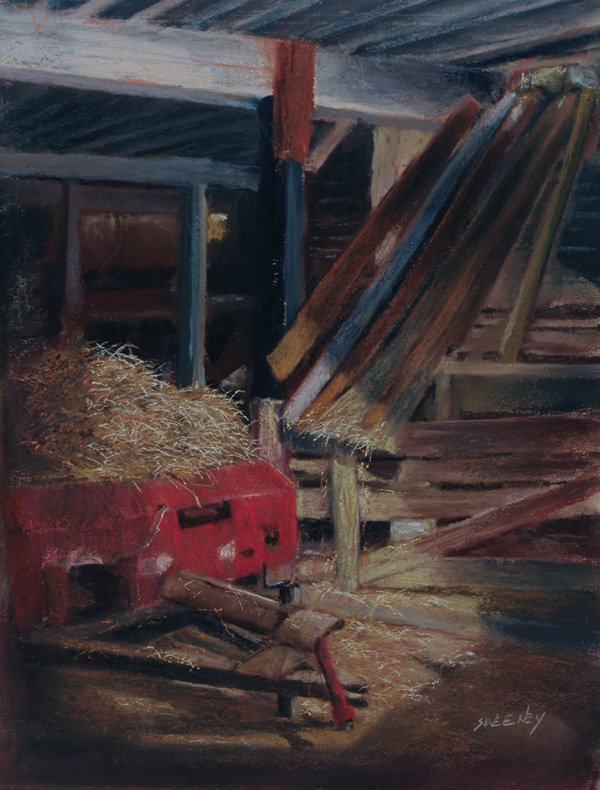
9_William_Sweeney_Hay_Shoot
Hay Shoot by William Sweeney

19.

She woke every morning with all her molecules lit. That’s what it felt like. Her body more alive than it had felt in years. The whole city was on fire. Fire bombed, fire forged from disaster at one point or another. And then shaped again with concrete. When she walked along the canal she saw men sitting on benches before they went to their offices. Their eyes closed, leaning against the back of the bench or bent forward, the slim egret and brave heron slicing past them in the air. One man bent over his dark trousers fanning his legs with a paper fan spread wide, picking lint off the dark fabric, another fed two cats crouched by the edge of a building. On her way to the university she passed a shrine. She could hear the monk beating a drum with a stick, a ringing sound that filled her with peace.


It was such a long time before she could put a sentence together after lightning struck her that time. After her stroke. Her therapist had sheet after sheet of exercises for her to do. Filling in sentences like a fourth grader. Dredging up grammar from the depths of her brain. Sometimes it felt like there was nothing there anymore. No word for key, or apple, or car. The trick was to search for nearby words that might give someone else some idea of what she wanted to say. It was a game. A trick. A way to pretend she was normal.

She stopped teaching. It was difficult enough to remember the word for son or husband, let alone plinth or column. But here she was teaching the history of art to five students from all over the place really. In the city for one reason or another.

“It’s such a short course,” she said to her husband and sons. “I’ll just be away for a couple of months.”

“That’s a joke, mom,” her older son said. “You’ll be most of the way around the world.”

“You’re so bored with us you want to get that far away?” Her husband asked and laughed. He was stirring sauce on the stove. Her older boy was setting the table. Jobs she once did without thinking.

When the occupational therapist had her make tomato sauce, she couldn’t remember how to use a spoon and picked up the smallest knife to stir the pot. This interchange of one thing for another was maybe not so bad. What did it matter anyway? In this country you used chopsticks.

20.

She passed a green phone booth almost every day. You could make a call there to someone in this country or internationally. She couldn’t remember the last time she’s seen a call box in her country. Country of ignorant men, country of tyrants and cars. Country of hate, country of bores. She wanted to make a celestial call. Every day she thought about her mother. What a strange thing to do. Her mother had been a pain in the neck, really, but still she was her mother and she missed her like she’d miss a hand or a foot or an ear. In all the stories she’d read there was a way to get what you wanted. And even if you failed, the story was the challenge. She wasn’t sure what she wanted anymore. For so long it was to talk again, to be part of the conversation.

Even if she opened the door to the phone box she wouldn’t know her mother’s number wherever she was. It was unlisted surely.

She passed a little girl with a pink hat as she walked away from the phone. She passed a man playing a song on a harmonica, something from a Broadway musical. She passed a little dog with soft pointed ears and bent to pet her. She’s six, her owner said. She was the first person Gigi had encountered on her walks who spoke English. She’s so cute.

She could feel the dog’s bones through her shining fur.

She passed a woman with orange shoes walking two dogs on two leashes who had bright orange booties. She passed the gray birds quarrelling in the trees along the canal and a woman picking berries from a bush.

If she picked up the phone and heard her mother’s voice what would she say? There were so many things to tally up as mistakes or losses. But here she was in a country that had lost so much. Whole cities obliterated, wiped clean in the war.

21.

“I just like reading,” her student said. “I don’t watch TV. I’ll be reading and the tea will boil or the dog will want to go out and I just can’t put the book down. The phone will ring, I still have a landline, or the doorbell will chime and I just can’t put the book down. The house will shake, or I’ll have to go to the bathroom, and I just won’t put the book down. Even when my father died, I couldn’t put the book I was reading down. It was about a princess. She’d fled to the mountains with her brave samurai general and a loyal handmaid. Her father had raised her like a boy instead of a girl. She was real swashbuckler. Prancing around in the mountains, her gold hidden, her dynasty in ruins. The samurai had offered up his sister, disguised as the princess on a platter, to save the royal line. The revolutionaries thought they had killed the princess and let down their guard. This was in oh, I think, about 1600, so it was cold in the mountains and the princess was hidden in a cave. She wasn’t content to stay there, though, and spent much of her time thwarting her own attackers, two peasants who had stumbled on two bars of gold in a stream. It all ended happily. That’s what I’m most worried about. Will everyone make it alive out of the story and get back into their lives.”

The student was from somewhere in England, somewhere in the north, Gigi thought. She was round like a ball and her head stood on top of her shoulders framed by blond hair. One of the other students, a boy, was her friend. He had tattoos down both of his arms, an insignia like an anchor on his neck. They needed the course to fulfill their art requirement, but they weren’t really interested in the subject. Gigi tried to make it interesting by showing movies and slides in elaborately constructed powerpoints. Her husband had helped her put things together before she left. Just follow the word on the powerpoint and you’ll be fine, he said. They don’t know the difference between a portico and a plinth, so it won’t matter if you mess up now and then.

She knew she didn’t tell her husband enough how much she loved him. That was the problem, wasn’t it? She was afraid he’d wake up some morning and realize he had poured so much wine into her chalice and all she did was drink and drink and never distribute the goods to the congregation. She didn’t say thank you enough for the hours he spent drilling her on vocabulary or the walks up and down the corridor of the rehab place until she could walk straight and not list to the side. Until she could get up off the floor on her own and the director said she was certainly ready to home.

Her student pulled a flowered kerchief out of her bag and wiped her face. Her friend laughed. Just like the woman on the train, he said. Not quite, she said, and tucked the piece of cloth back into her cotton tote.

Gigi had watched a mother and daughter share a handkerchief on the train, too. It was something people seemed to do in this country. The had shared hand lotion and then used the cloth to wipe the excess off of their hands. It was such an intimate thing to do. She had never had that kind of relationship with her mother. Her mother was always the princess. Her sister the handmaiden. The night before she’d dreamed of her mother, young and beautiful on the arm of her father. They were going to a party. She smelled of the spicy perfume her mother always wore. Her lips were painted bright red. She wore slim shoes. Her father smelled of aftershave. They were all glitter. Her brother had a tantrum after they left, and she told the babysitter to just ignore him. He’d turn blue and then settle down. He wouldn’t choke to death.

22.

She found, by chance, a small shrine tucked into the corner of a lane. It was a surprise that there were still these crooked lanes in a city that was so big you could drive for hours and still not escape it. She’d had a conversation about escape with Richard, her colleague who taught the music of the spheres. He really looked angelic, she thought. Spare, white, robed in the lightest of clothes. A kind of Zen impression of a catholic angel. He was one of the few people who seemed at all interested in her. Which was just as well. When she was anxious it was harder to call up the words she wanted. Her students were an incurious bunch of kids, so she hardly ever had to answer questions. She just walked herself through the information on the slides and pointed out the important details of whatever piece of art she was talking about and everything went smoothly.

The shrine was reinforced with concrete, covered with wood. Incense was burning. It was in the cool corner of a shady place. She’d read that the deities with the pink caps and pink bibs were in memory of lost children. This deity had a stained bib, the same kind she used on her two boys when they were babies. There were fresh flowers and sticks of incense in a little box. She slipped a coin into the slatted box at the foot of the shrine and picked up the slender stick of incense. She had lost a baby before her two boys were born, one and then the other not long after the first. It was a surprise to get pregnant so easily when she was not that young and then it was a loss so great she thought she wouldn’t recover for an instant when she sat with her husband in the waiting room and the doctor told them that the baby was gone, the slip of child just disappeared on the ultrasound.

Richard had told her he wanted to drive north to see the wild boars in the prefecture that had the earthquake and tsunami a few years ago. It was sort of a wacky thing to want to do, he told her, but then he never had much of a liking for normality. Even growing up. That’s probably why he ended up leaving the country even before things got so bad. He thought if he had stayed he would’ve ended up in jail, certainly, since that’s where most of his relatives worked. The huge buildings that took up so much space near the town where he was born.

23.

He only wanted to write about himself, her student told her, how his brain was on fire. How he couldn’t escape the thoughts in his brain, like someone hitting on the wall in his room and shaking it minute after minute. He wanted to clear out who he was and become someone else. He’d thought he would be a filmmaker, but that didn’t look like a good idea. He just didn’t get along in groups. He couldn’t talk.

“But you’re talking to me right now,” she said.

“Yes, but it’s just you and me.”

He wanted to be screenwriter, he thought, then he could work alone. She didn’t want to tell him at that point, the fluorescent bulbs in the classroom humming, shades tilted to let in the blazing light of noon, that everyone had to talk to someone unless you were a hermit and what chance was there of doing that in this place or this time?


She had gone to a poetry reading with her older son not long before she’d left the country and the poet told a story about his boyfriend who was living for a few weeks in a community of people who raised their own food, meditated on their lives, and went off into caves now and then to think. It was in the southern part of the country. A place where she was afraid once hiking in the woods and she had to avoid a man with gun who followed her for miles. Tracked her like a deer. The police called the poet, who wasn’t as famous as he would become, and told him his boyfriend had committed suicide. It wasn’t anything the poet expected his lover to do, so he called the coroner’s office and had the report sent. Suspected suicide, but several irregularities, the report said. Someone at he sheriff’s office said, No, it was definitely a suicide. The poet was even more suspicious and composed poem after poem about the tragedy. Years later filmmakers got interested in the case and read the coroner’s report and then interviewed the coroner. The poet’s boyfriend had been tied up, beaten, and then burned. It was certainly not a case of suicide.


Outside her window she could hear the blackbirds chattering on the trees below the balcony that lined the canal. They were squeaking and whistling, arguing over the berries that looked like mulberries. She had read the last empress of the country had raised silkworms and had her subjects spin silk. The empress also wrote 30,000 poems.

When she told her son, he said, “But mom, they were very small poems, weren’t they? It’s not like she was writing epics.”


Sharon White’s book Vanished Gardens: Finding Nature in Philadelphia won the Association of Writers and Writing Programs award in creative nonfiction. Boiling Lake, a collection of short fiction, is her most recent work. She is also the author of two collections of poetry, Eve & Her Apple and Bone House. Her memoir, Field Notes, A Geography of Mourning, received the Julia Ward Howe Prize, Honorable Mention, from the Boston Authors Club. Some of her other awards include the Neil Shepard Prize from Green Mountains Review, Italo Calvino Prize in Fabulist Fiction, a Pennsylvania Council on the Arts Fellowship for Creative Nonfiction, the Leeway Foundation Award for Achievement, a Colorado Council on the Arts Fellowship, and a National Endowment for the Arts Fellowship. She teaches writing at Temple University in Philadelphia.


 

Bacchanal

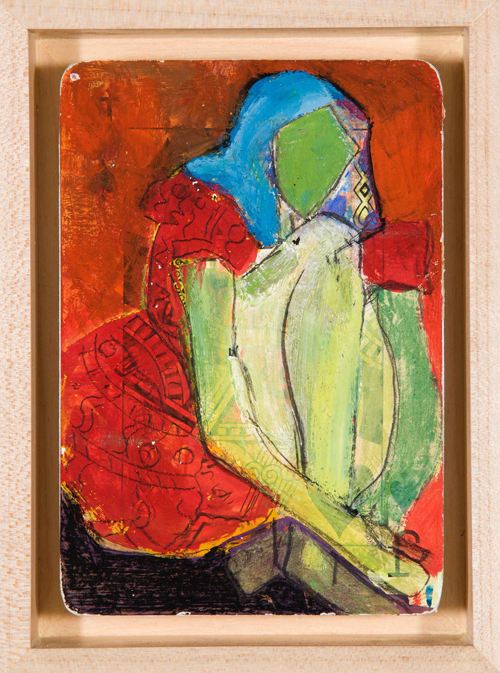
Annalie_Hudson_Friendship_Scratching_the_Surface
Scratching the Surface of Friendship by Annalie Hudson

She was a fast learner, an easy learner, therefore, a joy. She could be counted on, never late, sitting front row, her hair twisted twice, pulled and bound by a ribbon. She wore cream-colored sweaters, white blouses on very warm days. She was one of those rare visions: a freshman who’d taken cues from re-runs of Gidget or The Patty Duke Show and set about fashioning the exact college experience she had planned.

When he unbuttoned his sport coat before her or rocked on the balls of his feet and surveyed the rest of the class, his eyes finding hers, he was moved. He’d known other eager students who could toss back answers as if they’d studied the whole night before to please him. These students went on to respectable programs at respectable schools. Yet watching Rose-Lynn Coyle, listening to her read the work of Dryden, Pope, and Gray, how her voice would lilt at a surprising turn of phrase and sometimes laugh, Randall felt lifted, reminded of why he was a scholar, why knowledge and pursuit of knowledge had been and still were so very important to him.

One morning he asked to speak to her after class. His voice wavered, an embarrassing quality he thought had vanished with his youth. “Marvelous insight today,” he said. “The Rape of the Lock is nearly as sad as it is funny. That’s why we read it as a mock epic.”

“I wondered if I was reading it correctly,” Rose-Lynn said.

She was very small. He’d never stood close enough to realize how small, in fact, she was. “Are you thinking of graduate school?”

“Oh, I think about a lot of things.”

“Start planning,” Randall said. “Never too soon. You have something. A fire.”

“To be honest,” said Rose-Lynn, “your class is the only class I’ve been doing well in.”

He looked at her and smiled. She was wanting to say something more, he felt it, too. He watched her search for the words.


There were times when Randall took his good position in the department for granted. He—along with Merritt, Chouinard, and Wester—was branded one of “the senior statesmen,” a term reflecting the years he’d spent with the department, a term he didn’t care for. He was fifty-two, not particularly old. He had a full head of hair. Half the men in the department, years younger, couldn’t boast that. No lung cancer to complain of, as Chouinard did, often so busy he’d forget to eat yet never too busy for a smoke. Merritt, however, ate like a horse; his clothes stretched at the seams. And Wester, the oldest of the four, slowly, year to year, was losing his mind. Students complained of his incoherent lectures.

The English department, often thought of as “liberal,” was not a place of change. While the rest of the college grasped at modernization and physical reconstruction, English Hall remained true, was filled with dust motes and smelled old, like a place of learning. Sometimes, descending the main flight of stairs, Randall’s eyes would tear, considering the knowledge dispersed among the walls. What changes that did occur within the department were small ones, visiting lecturers, a revision of the previous year’s syllabus. There was a push to move more and more to the Internet, an experiment Randall had questioned initially but was nonetheless supportive of. John Goodwin, the new Romantics expert, had argued in favor of it.

Randall wasn’t sure of his feelings for John Goodwin. Goodwin was with the department only three years, the type of fellow one liked in order to forego the guilt of disliking. For an academic, John Goodwin was striking, with his big frame and dramatic voice and the beard he kept trimmed close, his eyes that always seemed caught up in clouds. Goodwin worked out four times a week. His criticism was sound. Randall had read each of his books, trying to find some small thing not to like about John Goodwin, but as he read Goodwin’s books, Randall could hear that booming assured voice, the voice that made everyone around him feel welcomed and wanted and at ease. No one denied the rumors about John Goodwin and his relationships with select students. But these types of things weren’t uncommon. Administrators spent salaries arguing the implications of such trysts, yet no written law—in the College Code or otherwise—prohibited them once a class was over. Those involved in such things did their best to keep hush. Whatever happened within the walls of English Hall didn’t escape those old walls, and what happened beyond the walls was under no one’s jurisdiction.

A relationship with a student had never, really, crossed Randall’s mind. He was married for twenty-four years, with two successful grown children, and in the scope of his own life, he thought himself a success. Everything he wanted, he had: a five-bedroom house with a clay tennis court, one grandchild, a cocker spaniel that retrieved the stick thrown for its amusement. Randall’s job with the college was secure. One night, walking home from a snack at the town restaurant, he’d turned to his wife, taking her hand that was cold from the snow. That night, there were buckets of stars, and as he looked down Main Street, he could see the gray of the Schuylkill, the black blocks of college buildings beyond. “This is all I’ve ever wanted,” he said to Lois, and she agreed. They hurried home. He poured brandy. They sat by the fire listening to Scarlatti until a log shifted in the fireplace. In a trance, they rose together. It was time to sleep.


Rose-Lynn appeared at his office hours, tapping at his door, until he told her that 3:30 every Wednesday afternoon would be the perfect time for them to meet. He’d make no other arrangements, that slot was for her and her only. “How do you like that?” he said.

He didn’t mind looking at the essays she brought from other classes. “I’ve put my whole soul into this one,” she insisted, “but still it doesn’t seem good enough.” He tried to show her where points trailed off, where her interpretation was faulty. “Write down exactly what you just said, it’s so good,” she told him. He recommended books she might turn to, important articles only a scholar would know existed.

One Wednesday afternoon, Rose-Lynn was in a state. “Professor Malvin hates me,” Rose-Lynn said. “She absolutely hates me.”

Malvin was not Randall’s favorite person. Students called her “The Vampire” because she’d written three books on those blood-suckers, one book on blood-letting, and three others on Victorian women and rape fantasies. Malvin always wore black, and her long hair seemed a shade even darker. Some joked that she was a witch, was good friends with Anne Rice. Some said she was Anne Rice. Of all the women in the department, Dorothy Malvin was the only one Randall would call a true feminist.

“She hates me because I’m pretty,” Rose-Lynn said. Randall had heard of cases like this, cases where Malvin favored fat girls, ugly girls, lesbians. “I turned in this paper, on time and everything, and still she gave me a C-.”

“A C-? That seems very low for your work.”

“She hates me. There’s nothing I can do.”

“Let me see the paper.” Malvin had scrawled red pen everywhere, the paper a bloody mess, an effect he was sure she intended. Malvin’s comments seemed reasonable, however; the paper did lack organization, showed no central thesis.

“I can see why you think she hates you,” Randall said. “Let’s you and I hate her back. Together.”

As Rose-Lynn reached for her essay, the tip of her fingernail dragged across Randall’s bare wrist, so slowly he thought it couldn’t be accidental, that slight but deliberate weight awakening his skin.


The last week of April, Randall found an invitation to John Goodwin’s 3rd Annual Bacchanalia stuffed into his department mailbox. Since Goodwin’s first term at the college, he’d been running the event, a party for faculty and the English majors held at his own home. The night was intended to be one of literary revelry. “Come as your favorite Romantic,” the invitation said. Randall had never previously considered attending one of Goodwin’s Bacchanalias, having heard that those department members who attended always left by nine. What happened after that, Randall could only guess. After Bacchanalia weekend, students in his Monday morning class looked exhausted, as if their lives had been spent.

“I received your invitation,” Randall said, passing Goodwin in the hall.

“You’ll be coming, will you?” said Goodwin. Randall knew Rose-Lynn had been a student of Goodwin’s, his class another of her trouble classes and Goodwin another professor who had her all wrong.

“Yes, maybe yes, I’ll come this year. I’ve heard good things.”

“The wine will flow freely for those of age.”

“And what will the children drink?”

“Blood,” Goodwin laughed. “Or Arizona Iced Tea. I hear it’s a hit with the younger set.”

Goodwin tapped down the hall into the department office. Randall was laughing, he didn’t know why or how, but the sound echoed up the stairs to the marble mural of Shakespeare. Then English Hall went silent.


“Aren’t you going to shave?” Lois asked.

“No,” Randall said. “Not tonight. I thought in the morning.”

“You look like an old bear.”

“I’ll be home before you know it.”

“I don’t like it when you leave,” Lois said.

“I won’t be long.”

“Here,” Lois said, searching the dresser drawer. “Even if you hate the idea of wearing a costume, at least try color.” She’d found a pink Hermes scarf with gold paisleys and tucked it into the pocket of his gray blazer. “Perfect.”

Goodwin’s place was two towns over, back from the main road, squared off by woods and cornfields with a windmill turning against the night. The house itself was three stories, a fine old structure with a balcony and a large tractor shed that was empty of tractors. He told Randall once how he’d bargained with the farmer to get this piece of land so private, just a flicker to anyone passing by along the main road.

Low music rumbled from the house, and once inside, Randall stood for a moment by the door. No one seemed to notice him. He went into a large room adjacent to the foyer, a sitting room. Candles, thin and thick, jutted from candelabras placed in the corners of the room, on windowsills, in sconces. Chairs, none matching in style, looked arranged by a madman about the large room. Boys and girls were done up as fairies, small nylon wings pinned to their backs, their faces painted pink and yellow and putrid green. He was sure the students had A Midsummer Night’s Dream in mind and wanted to tell them they were wrong: Shakespeare was Renaissance, not Romantic. There were courtiers and wenches, damsels, rakes, their faces vigorous, blushed with life. Two boys wore togas, Aristotles or Platos perhaps, a handful of Bacchae, someone as Mark Twain. Randall felt sick, lost in time, these literary histories were so crossed.

A few colleagues had arrived: Wester and Chouinard standing by the food table, the two of them done up, looking more like pimps or old nightmares than revelers. Dorothy Malvin was stationed by a window. She looked like herself, and Randall thought he’d ask her later who she’d come as, La Belle Dame sans Merci? Pouring red wine, hearty Goodwin chatted with Wester and Chouinard. Clearly Goodwin invested in his costume; the velvet and red tunic, much like a bathrobe, looked too good on him. He wore white leggings and his shirt was open at his chest. He caught sight of Randall and waved, coming toward him with a limp and carrying two glasses of wine.

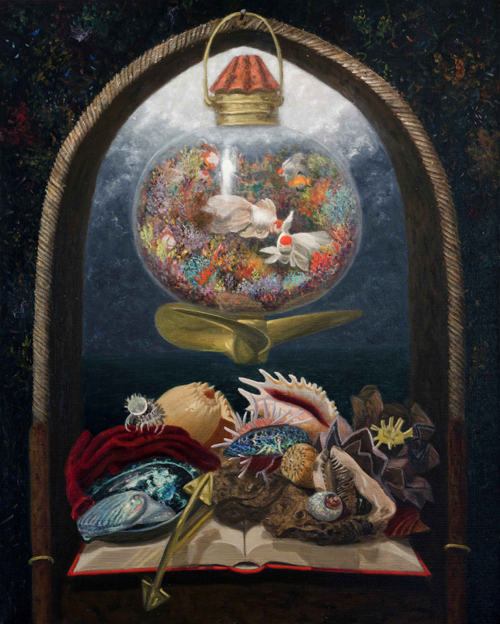
8_Eric_Loken_Lonaconing_Windows

Lonaconing Windows by Eric Loken

“Professor Turner, I see you came as a businessman,” Goodwin said.

“My fancy pants are at the cleaners. What happened to your leg?”

Goodwin bowed. “George Gordon, sir. Lord Byron.” Goodwin lifted the hem of his robe and showed a grotesquerie made to look like a club-foot. “It’s a killer with the ladies.”

“I bet it is,” said Randall. He wanted to say, “And the gents, too,” seeing as Byron was more noteworthy for his bisexuality than his poetry.

“Drink this glass of wine and get yourself another.”

“I will, I will,” said Randall.

“The masses await. But we’ll talk later, once things are up and running.” Goodwin crossed the room, patting students on their backs, rustling their hair as if they were infants, his children. Randall nodded to Malvin on the other side of the room, where she feigned interest in something caught under her pinky nail.

Several of Randall’s students chimed, “Hello,” in passing, then giggled. Out of context, students transformed into creatures other than the selves he knew in class. They became chaotic and careless, infantile. He had liked every single one of his students, but he often wondered if he’d met them some other way whether or not he would have cared for many of them at all. A number of them were drinking wine. Maybe they were seniors, which was possible. Seniors would be of legal age. He looked for Wester and Chouinard, but they’d left the room. Diana Regan and Tom Voll, the two glib Americanists, lounged in chairs by the fireplace. They seemed too interested in one another. There was really nowhere else to go, so Randall sucked in his breath.

“And who have you two come as?” Randall asked.

“Percy Shelley,” Voll said.

“Mary Shelley,” said Regan.

“How nice. The Shelleys. Not going to run off together, are you?” They looked at each other, smiled. The affection the two shared for one another, despite each being otherwise married, was far from private.

“We’ll see how the evening goes,” Regan said.

“Yes, we’ll see,” said Voll. “Never can tell.”

There was a trumpet blast, a silly thing pumped through the speakers. Goodwin was standing on a stool. “I’d like to welcome everyone to the 3rd Annual Bacchanalia. Or as you few repeat performers might know it, ‘A Dip in the Drink.’  I thought we’d start our evening with some grand verse and some grand meter. Let’s hear some odes, some ottava rima, two or three bout-rimés.”

A girl in a carnation gown and dark hair raised her hand. “Okay,” Goodwin said. “We’ll begin with our Claire Clairmont.”

This Claire climbed onto the foot-stool, looking pale and ghostly. “I dreamed my life was like a leaf / half-turned, then turned in full, tossed by the Wind / the evil Wind who frets the threads of fragile life / that laughing Wind who….”

Randall had never been turned on to student poetry, by struggling poetry of any sort. The Writing Department, the small and little thought of annex below English Hall stairs, was an assault to the greats: thinking that something like writing poetry could be taught!

Yet no sign of Rose-Lynn. He poured himself more wine. Mark Twain was reading now, a kid with a high forehead, Edward something. “Great minds have fallen and no fall is greater than mine / for it was I, Adam, father of humankind….” Nothing made sense, their mixing of historical and classical allusions, not following through with metaphors. Goodwin was sure to jump up after each one, clapping, rousing everyone to a cheer, no matter how bad the poem or how silent and disinterested the crowd. As he drank more wine, Randall had the sense these Romantic attempts at poetry might become easier to stomach.

It occurred to him that he’d like to see the rest of the house, so he slipped along the wall, back to the foyer and through the rooms on the first floor. Doing all the renovation himself, Goodwin had managed. There were no smudges along the ceilings, no signs of haste. Randall padded up the stairs to the second story, past one room that was being done-over; a belt-sander, sawhorses and paintbrushes littered the floor. He passed another room yet to be touched, then he came to what must’ve been Goodwin’s bedroom, not at all what Randall had imagined. There was no Gothic bedframe with white sheets and red satin pillows, no cherry oak furniture so rich and seductively dark. Heavy drapes didn’t obscure the windows. Instead, thin white curtains were pulled to one side. The bed sheets were gray and light blue and white, a simple country motif, and the furniture that squatted about the room was rustic to be sure, certainly not horrifyingly old, nothing European or imported, only a dresser and bedside table and lumpy green chair that looked as if they’d been garnered at some Sunday swap meet.

Was this the kind of person Goodwin was in his private life, soft and quiet, someone other than his self? Randall moved about the room, touching things, picking up a small bronzed baseball, horse-head bookends, a picture of two old women in a frame. He opened the top drawer of the dresser bureau: boring white underwear, just like he had at home, rolled into balls, stuffed among socks. He felt beneath Goodwin’s clothing. Surely that was where people hid the things they feared others would find. His fingers grasped at the glossy pages of a magazine. Pornography, he thought, but was disappointed when the shiny publication was nothing more than an Alumni magazine from Yale. Randall sat down on the edge of the bed, placed his wineglass on the nightstand and began looking through its drawers: green ear-muffs, a ruler, envelopes, pencils and pens, a Bible, a book on meditation, a novelty back-scratcher. Not even so much as one prophylactic: how very boring.

Then Randall heard voices in the hall, a high-pitched giggle, followed by footsteps. He knocked over his wineglass, red wine onto the beige rug, and ducked into the bedroom closet, leaving the door open slightly with a view of the room. At first, he thought he was about to witness something important. He imagined Goodwin, sweeping away one of the girls, carrying her like property up the hall stairs and tossing her down on the tidy bed. Yet it wasn’t Goodwin, not even someone half as interesting as Goodwin, some kid with longish hair and a soul patch, dressed as Puck, half-goat, half man, with nubbins of horns stuck to his head. The girl, Randall recognized. Kimberly or Kimmy. Or was it Kimbi? Kimi? She at least looked more of the period, not some fairy creature but voluptuous and indulgent, certainly Romantic. He’d noticed her before, once at school, at the vending machine.

The silly boy lay back on the bed. Watching, Randall was certainly aroused. He could tell both were not good kissers, more motion than technique. A sliver of saliva sparkled on the girl’s lips. Then, suddenly, the two burst into laughter and stopped. The girl straightened her gold hair ornament and went flitting into the hall. “Kimberlyn,” the boy called, but she didn’t come back. “Fuck,” the boy said, getting up from the bed.

When they’d gone, Randall slipped from the closet, into the hall, pretended to be casually descending the stair, and found more red wine. Lois didn’t allow him to drink much anymore—had reason to dislike his having too much—but she wasn’t here. The readings had come to an end. Popular music played, and the fairies were dancing. Light flickered on, then off, then on. Randall thought about that girl’s mouth, that geometry of saliva descending from her lips. He could no longer remember what it felt like: kissing young lips. He’d come to love Lois and her mouth, her kiss, yet he couldn’t remember what her lips felt like when they were young. The knowledge he once ardently possessed now escaped him.


Randall’s heart leapt: Rose-Lynn! She was so carefully articulated, her hair pinned and neat, suggestively pure, not sopping with sexuality. Over the years, students like that Randall had admired for their virtues and soon forgotten. Rose-Lynn, however, was art. Forging his way through the shaky undergraduates on the dance floor, he noticed the sprig of purple nightshade Rose-Lynn had secured with a barrette and the dark eyeliner that gave her the quality of the dead. She wore ballet shoes. He noticed too, unfortunately, she was laughing and in conversation with Dorothy Malvin.

“Rose-Lynn,” Randall said. “Rose-Lynn, who . . . who have you come as?”

“Oh, Professor Turner,” she said. “I’ll let you guess.”

“You get three chances,” interjected Malvin.

“Only three?”

“Here,” Rose-Lynn said. “I’ll give you a hint.” She closed her eyes and extended her arms in front of her. “Think somnambulist.”

“Just as I thought. Coleridge’s Christabel.”

“I suggested the costume,” said Malvin.

“Who have you come as, Professor Turner?” asked Rose-Lynn.

“Oh, don’t you recognize him, Rose-Lynn? He’s come as himself.”

“What better way to appear than as one’s self,” Randall laughed. “You can insist on being nasty, Dorothy, but I’ll remind you that you haven’t procured my promotion vote yet.”

“What’s one vote?” said Malvin.

“Lovers’ quarrel?” Rose-Lynn laughed.

“No love lost,” said Malvin.

“I’m sorry, Professor Turner, Professor Malvin, excuse me.”

Randall watched Rose-Lynn go, left standing with Malvin who too was watching Rose-Lynn go, slipping through the crowd like a breeze through a dream. Malvin was silent. Randall took a gulp of red wine.

“I like you, Dottie. You know, I really do.”

“I thrive in negative space,” she declared. “Sticks and stones.”

They didn’t say anything to one another after that. He waited for her to move away from him, and when she had, as he was sure she would, without another insult or an apology, he went to look for Rose-Lynn.


He discovered Rose-Lynn between the legs of a boy Greg on Goodwin’s back porch. The boy, perched on the railing, had crossed his heels behind Rose-Lynn’s knees. Rose-Lynn stiffened, seeing Randall there, and whispered into the boy’s ear.

“Let’s go for a walk, Professor Turner,” Rose-Lynn said.

“Yes,” Randall said. “Let’s.”

The backyard was nearly the color of dark wine now, the perimeters of each shadow red-tinged. Rose-Lynn pointed toward a cluster of trees at the end of the lawn.

“That boy’s just a tadpole!” Randall said.

“I knew you’d be jealous,” said Rose-Lynn. The trees at the end of the yard were arranged in a circle, a faerie ring, and at its center Goodwin had placed a cast-iron bench. Black roses twisted around one another, serving as legs. “Where’s your wife?”

“She hates these things.”

“I imagine her thin, old and pale,” Rose-Lynn said.

“She’s not so old or so pale. How old you do you think I am?”

“Fifty,” she said. “Fifty-two?”

“I was hoping you’d say forty.”

“You asked me how old I thought you were, not how old I thought you looked.”

“Ah. You seem older tonight,” Randall said.

“I’m an old soul.”

He could detect something in her eyes, a self-immolating fire, something that both excited and disturbed him. “Who are you?” he asked.

“I’m Rose-Lynn, silly. Who else would I be?”

“Some kind of bewitchment,” Randall said. “A snare.”

“You’re caught up in the night.”

“How can I not be?”

“Do you have any children?”

“Two: one son, one daughter,” Randall said, and then joked, “Do you?”

“No,” said Rose-Lynn. “I was pregnant once, abortion, etcetera. It wasn’t a big deal, just one of those things that gets in the way.”

“In the way of what?”

“In the way of everything. Nights make me think of children, I guess. The running around, the squeals as the sun sets. When I was little we played Haunted House outside in the yard, blankets thrown over lawn chairs. I could make the scariest faces.” Rose-Lynn screwed up her face, her eyes crossed, cheeks stretched. “I wasn’t afraid like other girls.”

“My children did the same.”

“I would’ve liked you as a child,” Rose-Lynn said.

“I would’ve liked you, too, but not in the same way as I do.”

“Let me get us another drink,” said Rose-Lynn. When she walked off, Randall worried she might not come back. He’d been left at parties by attractive women before. Sometimes he wondered if that was why he’d married Lois at such a young age when other choices might have presented themselves. Too quick to get everything right, to have everything in place.

Rose-Lynn returned with a red cup. “Here.”

“What’s this?” Randall said. “It tastes awful?”

“Cheap rum.”

“An odd after-taste.”

“Oh, that’s the roofies,” she laughed. “Drink it. I mixed it myself.”

“Really now?”

“It’s my second major.”

Randall chuckled and paused. “Do you have a boyfriend?”

“Who has time?”

“And Greg?”

“I love the gray of your hair, Professor Taylor. One of the few good things about getting older. Can I touch it?”

“Sure.”

She didn’t run her fingers through it as he wanted her to; instead, she stroked his head as if she were petting a cat. The motion made him feel suddenly woozy, and he found that he was willing to tell her everything: his impressions of the other students, the faculty, the college. “You’ve awakened something in me. Kindred spirits, you and I.”

“I should get to know myself then,” she said, resting her head in her hand and gazing toward the field. “What’s it like, being wise? I feel like I’ve spent my whole life being the opposite.”

“Everything will work out. It always does,” said Randall, yet as soon as he said it, he knew it couldn’t be true. Nothing worked out really, did it? The appearance of structure was a cage. Those Romantic spirits were right. The tall black stalks of the cornfield, so upright and sure of their positions, marching in rows yet journeying nowhere.

“I wish I could see further,” she said. “What lies beyond the beyond. Tell me how you think.”

“About what?” asked Randall.

“How you think when you think.”

He laughed: “Drinking will do this to us, make us philosophical.”

“Tell me.”

“For me, rooms build themselves around ideas. The planks of floors, walls hung with paintings curling in like fingers into an open palm. My thinking’s like that.”

“What am I doing there, in your rooms?”

“Meaning?”

“I’m there, aren’t I?”

She hadn’t taken her eyes from the line of cornstalks when her hand slid down the front of his pants. Randall bit his lip, then leaned to kiss her. “No,” Rose-Lynn said, her eyes still forward, peering toward some dark distance. It wasn’t at all what he wanted. It was detached, impersonal, and finished quickly, a fulfillment of two bodies inclining themselves toward one another, yet neither willing to live, to give in fully to that moment. When they did look at one another again, he to her, and her to him, it was with a sense of embarrassment of what they’d just made, a longing to return to the before.

“It’s gotten chilly, hasn’t it?” she said.

“It’s late,” Randall admitted, and Rose-Lynn smiled.


Driving, he felt at the tethered end of headlights, the illumined beams pulling him and the car homeward. The idea that’d resembled Rose-Lynn in appearance—which once might have stood gesturing by an open window or elongated on an upholstered chair in one of the rooms of his mind—had vacated, and only the dull hum of the radio found its way in now. It wasn’t a sadness that filled him, arriving home, but something else, a sloppy cousin to joy when Lois greeted him. “Some night?” she asked.

“I didn’t have much. Only a sip,” he laughed. “How was your evening? All quiet here?”

“I was reading,” she said. “Your pajamas are laid out for you.”

“I wish you’d gone with me.”


Rose-Lynn missed class on Tuesday and didn’t stop by his hours that Wednesday.  When she appeared the following week, she didn’t cheerily greet him as she usually did, but she didn’t appear upset or bothered. He called on her several times during discussion, found himself complimenting her responses more than he’d compliment other students’, just to let her know that he was still there, with her, despite what’d happened between them.

“Rose-Lynn, can we talk after class?”

“I have somewhere else to be,” she said. And it was like that for those few times after, even as she sat committing words to a blue book during her final exam: she had somewhere else to be. It was John Goodwin who told him later that Rose-Lynn would be transferring to Yale in the fall.


Born in York and raised in Dover, Pennsylvania, Michael Hyde is the author of What Are You Afraid Of?, a book of stories and winner of the Katherine Anne Porter Prize in Short Fiction. His stories have appeared in The Best American Mystery Stories, Austin Chronicle, Bloom, Ontario Review, and Witness. He attended the University of Pennsylvania, graduating with Honors in English, where he studied with writers Diana Cavallo, Gregory Djanikian, and Romulus Linney.

Like It really Is

6_Christina_Tarkoff_Streets_of_Philadelphia-Summer_Fun
Streets of Philadelphia – Summer Fun by Christina Tarkoff

My stepson is reading Romeo and Juliet for his eighth grade English class. I asked him what he thought about it the other day during dinner.

He shrugged and tucked a forkful of mashed potatoes into his mouth.

“I don’t want to ruin it for you,” I warned. “But it doesn’t end well.”

“I know,” he responded.

I told him that when I was in eighth grade, I memorized the entire balcony scene from the play. I didn’t tell him that I had done it because I prayed that someday soon, Jim Hurst of the swim team and I may have a similar exchange. Never mind that I lived in single level house in Florida, and the only impediment to our romance was my Coke-bottle eye glasses and his total lack of interest. I pictured a balcony at the Don Caesar, myself in an eyelet dress with sassafras wound in my feathered hair. Him, standing below, possibly in just swim trunks, would call up to me in a deep voice with only a hint of crack, saying: “I take thee at thy word. Call me but love, and I’ll be new baptis’d; henceforth I never will be Romeo/Jim.” Somehow, it would work out sans the dual suicide and despite the chasmic-sized popularity differences.

It did not. Wherefore art thou, Jim? (Actually, Facebook tells me that he’s a pro golfer living in St. Pete with twin daughters and a wife named Bethany Anne.)

But these early ideas of romance and storytelling stayed with me as a writer throughout my teen years as I struggled to come up with love stories that illustrated that same longing and defiance that captivated me at age thirteen. I’d write heroes with barrel-chests and tousled golden curls, heroines with eyes that were always a weird color—grey like slate, churning sea green (?), lavender. They were loosely based on a mixture of Shakespeare, the movie Blue Lagoon, and romance novels I stole from my aunt JoAnne. Inevitably, the women wore bodices and the men had ripped blouse-like shirts. I cared mostly about the exteriors, the long descriptions of the way waist-length hair rippled in the summer breeze or the man’s white teeth gnashed with desire, much like a stallion’s, the “maiden blush” bepainting a cheek.

I’d come up with these scenes and show them to my mom, an avid reader, who would concentrate on the lined notebook pages and hand them back with vaguely encouraging words to keep at it.

I knew what I was writing was phony, stolen. Until I was a junior in high school, I hadn’t been kissed. I hadn’t even been in danger of being kissed. There had never even been hand-holding. The closest I had come was a note from Steve Crossett, one year older and a red-head, who’d written that he thought I was “a pretty decent person.” Pin that one up on your bulletin board next to a photo of Christopher Reeves as Superman ripped out of Seventeen.

I asked my mom for advice. How did she think I should write love scenes? She paused, considering. I could see that she was weighing her options. “Write it like it really is,” she said finally. What did she mean? She thought for a minute. She knew that I spent an inordinate amount of time in the library, and very little time with the opposite sex. Unless you counted Wednesday night bell choir practice. “I mean, write about leaning into kiss someone and you miss. Or your elbow going numb on the table while you’re waiting for your date to finish his boring story. Write about what it’s really like, not what you think it should be like.”

This is possibly the best writing advice I’ve ever received, along the lines of well-worn maxim to write what you know. I had thought that writing was all about imagining yourself into the world you wanted to inhabit.  It is that. But it’s also about being able to see that situation as it truly is for your character—to picture all of its complexities and discomforts— the alive parts and the numb parts, the perfect moment and the awkward one. My love stories have mostly been awkward ones. Awkward, funny, lovely, horrible, and true. That’s the writing world I inhabit, and though I still love the tumbling poetry of Shakespeare, I stick to what feels most true to my experience.

Don’t Tell Me Your Childhood Was Not A Minefield

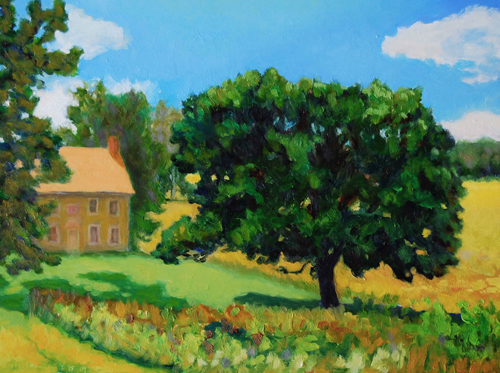
7_Jeff_Thomsen_Valley_Forge_Farmhouse_Summer
Valley Forge Farmhouse, Summer by Jeff Thomsen

A review of Thaddeus Rutkowski’s Guess and Check


An effective technique in poetry is to guide the reader on a journey that feels like you’re discovering together as opposed to resorting to a heavy-handed didactic approach. Guess and Check is not a collection of poetry, however, Rutkowski employs this tactic as we follow his protagonist on life’s obstacle-ridden path; a process of trial and error while navigating a magnified reality—scenarios wild enough you want to believe they couldn’t possibly happen, but not far-fetched enough to be disregarded as absurd. As a result, these stories uncannily hit home. You get that back of your head worry—somewhere in America lives are unfolding in a frighteningly similar fashion.


The family dynamics in Guess and Check illustrate how a person acquires life experience—often in bits and pieces, by hearsay and chance—like the child who touches the stove and learns it is hot, Rutkowski’s protagonist puts his finger in his father’s fly-tying vice. His father initially shows him the vice saying, “You should learn to make something useful.” Playing with the vice later, the child notes, “My fingertip would have burst if I’d kept going.” In Guess and Check, all is consistently on the brink, consistently on the line.


Guess and Check is a thought-provoking book, subtly nudging the reader to reflect how our choices shape our reality and lead us to our present selves. Engaging with the text, here’s something that tumbled onto the page after sitting with G&C for a while: We learn lessons over and over. Mind you, I don’t mean we learn the same lesson over and over, although certainly in some cases that is also a truism. Rather, my sense is we adopt a methodology for lesson learning, and we rely on this strategy to find our footing in any new circumstance. At some point, we all learn that fire burns. How we learn that fire burns is what makes us individuals. The branch splits with each choice creating the unique tree that is a human life.


Reading these stories, I occasionally felt Murphy’s Law—that anything that can go wrong will go wrong—was somehow at play. The following, though it may appear to be a low stakes example, illustrates the point well—if you can’t even manage the energy to secure a decent night’s sleep it feels the universe has aligned against you.


Once awake, I noticed that the air had gone out of my mattress; I was resting on the hard floor. I blew up the mattress, but I was too tired to inflate it completely. When morning came, I was again lying on the floor, with only a sheet of plastic between my body and the wood.


Instead of dwelling on grim fatalism—calling to mind Hunter S. Thompson’s term “The Doomed”—Rutkowski’s characters are resilient—they don’t get down on themselves, they roll with the punches. After a scene of brutality, in the next vignette they generally seem no worse for the unpleasantness experienced before. Or perhaps, these characters are simply that well-trained in compartmentalizing the horrors. You put them in a box, you put that box in the attic, and you do not enter that attic under any circumstances.


What I said about characters managing to appear undamaged is not wholly true. From scene to scene the protagonist may seem to cope, but then you’ll wince watching his exposure to abuse without displaying emotion. Of course, this is a survival mechanism—but from the outside looking in it’s frightening to bear witness to the learned behavior response that results from repeated trauma.


When a teenager shoots one of the family dogs and the protagonist confronts the teenager for an explanation, the teenager says, “He was running across my yard, so I picked up my .22 and plugged him.” The section breaks here.


Violence and gunplay escalates throughout the text. Here too there seems to be a lesson about indoctrination into normalcy. Later, the protagonist is living in New York and decides to reclaim a gun his father had given him as a child. He looks into obtaining a permit, but the paperwork is cumbersome. He opts not to bother with the paperwork; possession of a firearm is simply not a big deal to him. After all, he grew up around guns.


He’s babysitting a child one day and lets the child handle the weapon. When the mother arrives to pick up the child she is less than pleased.


In this next gunplay example, Rutkowski’s dark humor comes through:


“Did you have to take a course to learn how to shoot?” my friend asked.
“Yes,” I said. “The instructor set up a cabbage and told us, ‘This has the consistency of a man’s head.’ Then he pointed a shotgun at it and pulled the trigger.
“My god,” my friend said.
“Just showed what could happen.” I said.


Rutkowski employs humor that offsets the frenetic uncertainly and darkness. And the humor increases when the protagonist is an adult. The reader can bear in mind that there are glimmers of light at the end of the winze while navigating the dangerous waters of childhood that occupy the early sections of G&C.


Here’s a glimpse into Rutkowski’s protagonist as an adult:


Later, I walked my guest out to the street and helped her hail a cab. I must have been nervous, because when I shut the car door for her, the metal frame hit me in the face.


Before I wrap up, here are a few more examples of Rutkowski’s memorable voice:


Even in daylight, the flames were filled with energy.
In the shared kitchen I found lizards living behind the appliances. They were geckos of some sort. They clung to the walls when I made coffee. Maybe they liked the heat radiating from the stove coils, or maybe they just liked clinging to walls.
He said he wanted to go to the bottom of the pit. He said he was already there.


In these vignettes, Rutkowski offers lessons that are not always clear cut. And, at times, you’re left wondering what it all means, what kind of lasting effect would these experiences have on a person. As the protagonist is followed from childhood to adulthood, I kept wondering how someone could undergo all of these damaging experiences and come out on the other side unbroken. Maybe that’s a question Guess and Check requires of its readers. Who among us can say they’ve made it this far unscathed?


Gettysburg Parable

After his speech the people
who’d assembled to imbibe

the mulled wine of his baritone
went home and tried to rebuild

everyone, while the President
click-clacked back to Washington

wreathed in the steam of engines
he’d unleashed then stalked

like a gaunt apostrophe across
the street to telegraph Ulysses

Grant to “please come get this
business over with” before his

hair made wisps of smoke like Little
Round Top and his bristling jowl

grew sunken into Devil’s Den
chewing its hallowed dead.

“Expect worse”
Grant’s reply read.


Ed Granger lives in Lancaster County, where he was raised to love both books and theoutdoors. Since returning to PA in 1993, he has volunteered and worked for healthcarenonprofits. His poems have appeared or are forthcoming in Little Patuxent Review, TheBroadkill Review, Potomac Review, Roanoke Review, Free State Review, Naugatuck RiverReview, The Sow’s Ear Poetry Review, and other journals.

Dear Pylvia Salth

I am drunk

& listening to 4:49 a.m.

in the shower again

on repeat, thinking that


if steam handles lips

the way hands

handle match tips, then you


handle me the way

“too” handles “close”


(& there may never be enough

hot water).


Now, think of all the things

we can count on

our fingers


like the certainty of

smoke:


when it fails to leave a

burning thing behind,


we choke.


Born and raised in northern New Jersey, Kayla Coolican is a freelance writer and poet based in Somerville, MA. A student at Lesley University and regular performer at The Cantab Lounge, she adores collaborative work, and spends her free time as the volunteer editor for a local indie lit-mag. In Cambridge, she is best-known for her steamy spoken-word piece, “Seducing Johnny Appleseed,” featuring in numerous Boston slams and solicited for radio performance in 2016.

Kayla also nurtures a quirky art portfolio and enjoys pairing her written work with Apidae-inspired illustrations. She looks forward to completing her first chapbook soon

Madagascar

The island is this:
rimmed with trees
over centuries
the rest gone
for firewood
unrestrained
red clay soil
bleeding into the sea
That’s how I felt
when you left
ninety percent gone
and that tossed to the breeze
ash
char
the axe-man’s chuckle
I still burn
hope
this finds you as me:
out in mid-Ocean
smoldering


Steve Burke lives in the Mount Airy section of Philadelphia; has been published in various journals, read at many venues about the area; in 2014 had his chapbook After The Harvest published by Moonstone Press; has two book-length MSS-in-waiting — 36 Views Of Here and Nothing Doing.

The Man in Building H

He splits cells and grafts them together,

an art he perfected with his children, a family

crafted from multiple marriages. Microbiology

is not often associated with the domestic,


but he was raised in the years when a station wagon

had bench seats big enough to haul little sisters

to the skating rink, little brothers to the ballpark.

He still wears the same L.L.Bean ushanka


from those chilly college days, when he paid

for State with side gigs and scholarships.

He took a job to pay for his weddings, his church tithes,

and those five kids he put through college, no matter


the picket lines that winked on and off

like Christmas lights outside his windows:

people who think pharmaceutical research is conspiracy

to make the rich richer and the poor sicker.


His eldest daughter is waiting for him now, shivering

at the ——ville platform, back from a world removed

from this germ warfare.  He wants for her what he has:

a family, a pension, Americana unbroken. She laughs.


He doesn’t mind his children’s selfishness.

At night he locks away his stains and slides

and passes through door after locked door,

the virus sleeping cleanly in the lab behind him.


S.R. Graham is a Pennsylvania native currently enrolled as an MFA student at the University of Florida.

Combustible

2_Tilda_Mann_Blue_Haired_Girl
Blue Haired Girl by Tilda Mann

Grace and I met six months ago. Mutual friends who had been conspiring to get us together finally succeeded.

We decided to meet at a popular local diner for coffee. I arrived early and sat on a fake leather bench in the cramped lobby with others who were waiting to be seated.  I nervously tapped my feet on the floor.

The anxiety of this first date must have also shown on my face. A middle-aged lady sitting next to me to my left asked, “Blind date?”

I turned toward her, sheepishly grinned, and answered, “Yes.”

“That’s how we met, almost ten years ago,” she said, and motioned with her head to the man sitting to her left. The hostess called their name. As they stood, she looked back at me, smiled, and said, “Good luck.”

I gave a half-hearted smile in return and mouthed the word, “Thanks.”

Although Grace and I had no idea what each other looked like, other than vague descriptions our friends gave us, we instinctively recognized each other when she walked through the door. She had a smile like Annette Bening, and that was all I could see.

It was six p.m., the height of the diner’s dinner trade, but we managed to corral a window booth. Grace and I bonded and trusted each other immediately. We talked over coffee for five hours. I left the waitress a generous tip for allowing us to rent her table. Now in our sixties, Grace and I decided we didn’t want to go through life alone anymore. Two months later, she moved into my apartment.

One night, as we lay in bed, Grace asked, “How would you describe our relationship, Lewis?”

She has a knack for asking these weighty questions at the most inopportune times. It’s always when I’m ready to fall asleep. Somehow, she knows that’s when I’m most vulnerable.

“What?” I asked incredulously as I rolled onto my right side to face her. She had already turned off her lamp. My eyes squinted as I tried to focus on her, aided only by the broken bands of light from the street lamp sifting through the blinds behind her.

“How would you describe our relationship? It’s a simple question.” The muffled sounds of midnight traffic rose from the street two floors below our apartment.

Perhaps for her the answer was simple, but not for me. I was no more prepared to answer that question in my sixties than when I had to answer it forty years ago in my twenties.

“Not at this hour, when I’m exhausted and want to sleep. And why would you ask that particular question now?”

“Because this is the perfect time to talk—when we’re together and have no distractions.”

She’s right, partly. With our schedules, it’s probably one of the few times we get to talk to each other. I still work a full-time, modified, second-shift job. I rarely get home before ten p.m. and, by then, I just want to vegetate. Grace is retired, but teaches both a day and evening English as a Second Language class on a volunteer basis.

“You mean other than attempting to get some sleep before I have to wake up in six-and-a-half hours?” I asked.

“Well, that’s an hour longer than me. I’m up at five-thirty.”

“That’s out of habit and your choice, Grace, not mine. Good night,” I said as I rolled back facing away from the window.

“And where are you going?”

“Hopefully to sleep, please?”

“You’re not answering my question, Lewis.”

“I thought I just did,” I mumbled into my pillow.

“I heard that, and it’s not the answer I was looking for.”

Lord, help me. Exasperated, I turned on my nightstand lamp, rolled over once again to face her—like a dog learning a new trick, propped my pillow up against the headboard, and sat upright. “Christ. You really want to know?”

Grace is a pebble compared to my boulder-like build. She inched closer to me, reclined, placed her left hand under her head as a prop, and said, “Yes. I really want to know. And don’t bring Him into it. I asked you, and He’s not going to help you answer the question.” I’m Jewish. Grace is Catholic, and she doesn’t take kindly to me using her Lord’s name cavalierly.

“Why?”

“Why He’s not going to help you?”

“You know what I mean, Grace. Why do you want to know?”

“Because by knowing what you think and feel, I believe we can make our relationship better, stronger.”

“Okay. That’s a valid point, I guess.” I was doing my best to appease her.

That may have been her goal, but from what I know about Grace’s past, I believe the question stems from insecurities about where she stands in a relationship. I struggle with those same doubts, as perhaps most people do when embarking on a new association, whether it’s personal or business.

She’s had two marriages. Her son and a daughter were from her first—which lasted only six years, and was fraught with her ex-husband’s infidelities. The second was almost four times longer and ended when she became a widow. That was seven years ago.

I had only one marriage that endured longer than both of hers combined before I called it quits. With my ex, what I did was never enough. Never enough money, affection, attention. My worth, to her, was ultimately reduced to what I could give her. Our three children have the same mindset. My relationship with them is strained, at best.

Grace and I have shared morsels about our past relationships, her more than me. I’ve lived my life on a need-to-know basis; the truth comes out in dribs and drabs at my convenience. Perhaps—no, not perhaps—I know that was one of the many reasons my marriage ended in a heap of hot, smoking ash. I reluctantly shared that with Grace. She asked me to promise her that I would do better in our relationship. I said I would, and I always do my best to keep promises.

I’ve managed most of my insecurities: not being a good enough provider or father and husband, which stem from my previous marriage. There are probably also a few that I’m not conscious of, or willing to admit, but I still feel their effects. Those are buried so deep that some shrink attempting to excavate them, like an archaeologist digging for the bones or artifacts of an ancient civilization, would likely first find Jimmy Hoffa’s body.

Most of Grace’s questions are innocuous and odd, but somewhat humorous. She can be so endearing, but it’s when she asks questions about us that those entombed skeletons uncover themselves and rise to the surface. I don’t know why I’m unable to keep them interred.

I tried to deflect. “So, let me ask you the same question. How would you describe our relationship?”

“I asked you first, Lewis. I’m calling your hand.”

I took a long pause and slowly shook my head. I don’t see any way out of this. “It’s like when I was in ’Nam, on the river boats.”

“How so?”

“It was hours, sometimes days, of boredom split up by moments of sheer terror. You just never knew when the next attack was coming, or from where. Like now.”

She responded matter-of-factly, “So you’re equating my question to an attack?”

“Kind of. Not a frontal attack, mind you. Just coming out of nowhere.” I wasn’t smiling, and my tone was dark and anxious.

“Interesting,” she said, staring at me.

Every time she says that and gives me that stare, I know she’s thinking of another question, and each succeeding question gets more intense, more focused.

“Then does my question scare you—terrify you?” she asked.

“No. Not exactly.”

“Then what?”

“It’s damn annoying. It frustrates the hell out of me.”

“I believe what frustrates you is that you know the answer and are afraid to face it.” Her tone softened, and she smiled. “You’ve gotten so much better at opening up, Lewis. I truly mean that. Just answer the question, please, and we can both go to sleep.”

Her smile was convincing, and I bought it. I wanted to buy it. It was the same smile that beguiled me the first time we met.

I’ve learned that Grace was a damn good prosecuting attorney in her life before retirement. It showed at times like this. She used her charm before asking those final piercing questions, which felt like the last thrusts of a dagger into some woefully unprepared witness.

“No. That’s not the way it works with you, Grace, and you know it,” I said, even more agitated. “You’ll have twenty more questions. You always treat me like a hostile witness in these bouts, and I know I won’t be excused from the witness chair until you’re finished with me. But truth be told, I mostly feel that you’re prosecuting some ghosts—not me—and it’s not fair.”

She didn’t directly address my anxiety. Instead, she said, “I promise this time I won’t. Answer the question and we can both get some much-needed rest.”

“Promise?”

“I promise.”

Once again, I was sold like some buyer on a used car lot being told that the car I was about to purchase was only driven to church by a little old lady.

“Fine.” Here it goes. “Living with you is like residing in a fireworks factory where they allow smoking. It’s not if there will be an explosion, it’s when.” The explosion was coming from within me. This is my previous marriage all over again, I thought, always having to prove myself.

That retort apparently got her attention, because she now sat upright, no longer assuming the pose of a Roman emperor eating grapes and sipping wine. Her dark, brown eyes narrowed and focused directly on me. “What are you saying?”

“I’m saying we’re combustible, Grace. Your questions are like an open flame around gunpowder.”

“Bullshit, Lewis! We’re not combustible. You’re combustible.” She pointed her finger at me, and said as emphatically as she could, “This isn’t about me. This is about your ex. Isn’t it? Just admit it.”

“I’m not admitting to shit, Grace, because that’s not true,” I groused. “This has absolutely nothing to do with her.” But it did. More so, it had everything to do with me believing I wasn’t good enough for Grace.

“The hell it doesn’t. It’s always about her when it comes to us. Talk about living with ghosts!” She rolled her eyes, smirked, and shook her head.

I was losing ground and Grace knew it. She was about to unsheathe that dagger.

“Well, here’s what I really mean, Grace,” my voice elevating to match her finger pointing. “You ask these off-the-wall questions…”

“Oh. So, questions about our relationship are now off the wall?” she cut in.

“No. You’re twisting my words. I mean I just never know when those questions about us are coming, and that’s what terrifies me!” What really terrified me was that Grace might believe I’m not worthy of her, and I didn’t have the courage to say so. What if I wasn’t?

“There you go, Lewis. It’s only when I ask those questions about us. Thank you for finally admitting it. And it really doesn’t matter when I ask them, does it?” She paused. “DOES IT?”

Grace folded her arms across her chest and looked away. She wasn’t fishing for a response. Like any good prosecutor, Grace never asked a question to which she didn’t already have the answer.

I took a deep breath, collected my thoughts, and added sullenly, “I’ve fought one war in my life. I’m not going to fight another one. This relationship, like my marriage, is beginning to resemble Vietnam. Except in ’Nam we used bullets, not words. But the effects are the same: the walking wounded.” I sighed deeply, and I said, “There’re only so many conflicts a person can fight, and I want to be done with all of them.”

Grace turned her head toward me, her arms still folded. I couldn’t decide if the look in her eyes was hurt, anger, or confusion. At that moment, I wasn’t sure if I cared. I just wanted the discussion to end.

“What do you mean, Lewis?” Gone was the confidence in her voice.

In hindsight, I did care because I tried my best to limit the damage of that combustible moment. I gently slid my hand to touch her arm. “Grace, I’ve learned over the years which battles to fight, and fighting to keep us together is one endeavor I’m more than willing to undertake. I’m not a conscript in this battle. I’m a volunteer. But please, stop treating me like a combatant. Start treating me more as a medic.” I just wanted to be someone who stopped the bleeding and saved the patient, but I wasn’t sure if the patient was me, her, or us.

I asked Grace to look at the sign that I made which hangs by our bedroom doorway. It reads: “I would rather be crazy with you, than sane without you.”  Then I leaned into Grace and said, “Why can’t you just accept that I love you—that I’m in love with you—and that I want us to work?”

I could see the corners of her mouth turn upward ever so slightly. Then she spoke. “I suppose I like fireworks, Lewis.” She kissed me and then said, “Now go to sleep, sweetheart. I know I will. It’s late.” Grace rolled away from me.

I turned off my light, realizing that our conversation ended the same way it began—with me in the dark.


L.D. served seven years in the Navy, which included a combat tour in Vietnam on river boats and five years aboard nuclear-powered, Fast Attack submarines. At 67, his life is quieter now. He lives in a small city in southeastern Pennsylvania and is a member of The Bold Writers group.

His short stories have been published in, among others: Red Fez, Indiana Voice Journal, Remarkable Doorways Online Literary Magazine, The Writing Disorder, The Furious Gazelle, Slippery Elm, Cobalt Review (Print), and Evening Street Review (Print). He has had several public readings at Albright College in Reading, PA.

L.D.’s website is: ldzaneauthor.com.

Like Nothing Happened

3_Joanne_Barraclough_Life_in_a_Fishbowl
Life in a Fishbowl by Joanne Barraclough

It’s an hour drive from our office in Wilmington down to Dover, and my colleagues wanted to carpool, so I’m praying something goes wrong.  Getting pulled over speeding is the most likely possibility—lots of state cops patrol Route 1, snagging cars that are just over the speed limit.  Maybe John could suddenly feel ill and cancel the whole thing.  He’s the owner and founder of the firm, but he’s on his way out.  He’s finally retiring in a few months.  He’s sitting in front of me, in the passenger seat.  Harris, my boss, is driving his leased BMW. The back seat is uncomfortable.  It’s raining outside.  Everyone on Route 1 is driving sensibly, including Harris, except for this little Kia that passed us a little while ago.  And then, there it is, pulled over on the side, with a cop standing in the rain at the passenger’s window.  Harris slows down to fifty-five as we go by.  I’m stuck here.

The good thing is, I’ve taken the afternoon off.  I knew this morning would be exhausting.  I can maintain my friendly, charming, professional face for only so long before I can’t do it any more.  This is an hour down, probably at least an hour meeting, and then an hour back up.  My only saving grace is that Harris has an early afternoon meeting, so we can’t do lunch.

“See that, Thomas?” John says.  “That’s what I was talking about.  As soon as I saw that little heap fly by, I knew he was a goner.”

“He had an appointment in Samarra,” I want to say, but that’s too weird for these two.

“Especially in this rain,” I say instead.

A lot of people in business question the value of the arts.  I learned to act in the theater club in school.  If not for that, how would I be able to act like a normal person?

#

Delaware’s Public Archives are in a large brick building with a striking, glassy cylindrical façade.  We’re there to deliver a presentation on a potential marketing campaign.  The Division of Archives had put out a request for proposals, and John thinks it’s going to be easy pickings.

We hurry in to get out of the rain.  Harris signs in for us, and the girl at the desk tells him that it’s going to be a few minutes.  I walk around and look at the current displays.

It turns out that the Director of the Archives has a meeting with the Chief Deputy Secretary of State, and it’s going long.  Harris and I should’ve spent more time on the presentation.

At the same time, I like it when John is revealed to be out of touch.  He thinks he can just bank on his past reputation, but he can’t keep up with the present.  We recently lost a client because, at an event, John took credit for some creative that the client had actually designed in-house.  The conversation got back to the client.

Finally a staffer leads us into a conference room, and then the Director and two more of her staff members join us.  All women.  I can already hear John complaining about it.  On the way home, he’s going to say that it used to be that you’d sit down with some government guys at Fraizer’s Restaurant, have some beers, and hash out a contract.

We would’ve been better off bringing John’s wife.  She’s number three for him.  She’d been previously divorced herself, and she went into this marriage with eyes wide open.  She has a fun sort of cynicism about her.  I used to flirt with her at staff parties. She ignores me now.

The Archives staff has all sorts of insightful questions that we’re not remotely ready for.  At some point, I tell a lie about doing research there in college, for no other reason than to make it seem like we aren’t completely clueless.

As we’re walking out of the building, a young woman comes striding in.  She’s a tall, thin redhead in a long black coat and black rain boots.  I hold the door open for her, and she doesn’t acknowledge me.  I recognize her from somewhere, but I can’t put my finger on it.

“Let’s get out of here,” John says.

In the car, Harris tries to put a positive spin on things.  He says that the Division of Arts has just put a request out, and that we’ll have a better idea of what state agencies are looking for in the “present climate.”  I want to tune them out and figure out how I know that redhead.  But I know that if I do that, I’ll end up staring out the window and seeming like a nutty spacecase.  So I force myself to make occasional contributions to the conversation.

I’m going to drop dead if I don’t have some coffee.

#

Harris and I chat for a few minutes at the office and then he takes off.  I go through my emails while eating lunch at my desk.  Then I’m out.  I stop at Dunkin Donuts for a coffee.  The weather has improved, slightly.  The rain has stopped, leaving us with a miserable, gray December day.  Maybe my therapist will brighten things up.  I have a one-thirty appointment.

I hop onto the highway because it’s the quickest way to North Wilmington.  Right now I’m driving a black Acura.  I prefer the feel of my previous car, a V6 Accord, but the Acura has better looks.  I roll along the Concord Pike and its various strips of retail shopping.  I’m starting to relax.

I sit in the waiting room, reading an issue of Sports Illustrated and drinking my coffee.  Dr. Flynn calls me in, right on time.

I sit down on the couch.  Dr. Flynn makes some notes at her desk and then sits on the leather chair that faces the couch, with her white pad of paper on her thigh.  She is in her 60s, older than I usually go for.  She’s taller than me in her high heels and meaty.

I take stock of today’s outfit.  Blue blouse under black sweater, black pants, no socks or stockings, two-inch black high-heels.  Faint eyeliner, red lipstick, an odd assortment of rings and bracelets.  I believe that over the course of the year or so that I’ve been seeing Dr. Flynn as my therapist, her clothes have gotten tighter and tighter.

“How would you describe your mood today?” she asks.

I can feel a smile pulling my lips along.  I show Dr. Flynn more of myself than I show most people.  “I’m pretty excited,” I say.

“Why is that?”

“I had a meeting for work today, and I saw a woman who I know I recognized from somewhere.  It took me a while, but now I remember who she is.”

Dr. Flynn crosses her legs.  I detect a faint bounce in her aerial foot.  More and more, I feel compelled to ask her to join me on the couch.  I think she would—if I asked her.  What would I call her during sex?  Dr. Flynn?  Lisa?

“And who is she, Thomas?”

“She’s a go-go dancer.  I saw her in small club on South Street in Philadelphia.  She wore a leather vest and denim skirt, and she danced to ‘I Wanna Be Your Dog.’  That’s an old Stooges song.”

Dr. Flynn watches me for a few seconds without speaking.  Then she asks:  “Do you think that’s really the case?  Or were you having a fantasy?”

“John and Harris saw her too.  I held the door for her.”

I realize I sound defensive.  Dr. Flynn waits for me to say more.

This reminds me of our conversations about John’s wife.  I get the sense that Dr. Flynn only believes around half of what I tell her, maybe not even that, which is a big part of why I feel so relaxed around her.  I don’t think she takes me all that seriously.

“I’m not planning on making a big thing about it, if that’s what you’re thinking.”

“What would constitute a ‘big thing’ to you?”

I enjoy her repetition of my words.  I lean back and cross one leg over the other.  “As in, I’m not going to go hang around the Archives to try to bump into her again, and ask her if she dances in Philadelphia.”

“I think that’s a prudent decision.”  She looks down and writes something on her pad.

“I’d be more inclined to go back to that club the next time I get to Philly.  I could tell her she’s very memorable.”

“Do you think she would appreciate that?”

“Wouldn’t you?”  In a movie, Dr. Flynn would stride across the room and slap me, and the tension would electrify the air.

Instead, she says, “Did you ever go back to the woods?  Where Jillian disappeared?”

#

Candy—not her real name, ha ha—is in a bathrobe when I get to her place.  She lives in an apartment over a convenience store in Claymont, a couple exits up I-95.  I found her in the back page section of an alternative Philly newspaper.  She tells me to wash up while she gets ready.  This is the downside to going to her place—the shower is not a pretty sight.  I wonder if she takes baths in there?  I shudder at the thought.

I’m not going to let my visit with Dr. Flynn prevent me from having a good time.  Dr. Flynn brings Jillian up fairly often, often enough that I shouldn’t be surprised when she does.  But when she does, she does so gradually.  She asks my permission:  “Can we talk about Jillian today?”  She’s never come at me out of the blue like this afternoon.  It feels like a new step in our relationship.  It’s in the open:  She wants to dominate me.  Perhaps she believes she can provoke me into saying more.

Later on, when Candy and I are in bed, I ask her if she could bring me a little whiskey.  She takes heavy steps into the kitchen and then practically drops the glass on my chest.  Once she’s been paid and we’ve had our visit, she wants me to get out.  But the lounging is one of my favorite parts.

“Next time, I’m going to ask you to dance a little bit for me,” I say.

“Drink up,” she says.

I can’t stop imagining her submerged in her bathtub, her dead face just below the surface.  Like this is a movie where I can see the future, and my awareness of the possibility of her death allows me to prevent it.

It wasn’t a movie that put that image in my head though.  It was the police, back when Jillian was missing.  They questioned me for hours.  I was twelve.  My mother was fine with it—whatever it took to find Jillian.

I remember the names of every detective who spoke to me.  Franklin was the worst.  “You watched her drown,” he said calmly.  “Her face was under the water, but her eyes were open.  You kept her down there, and then her eyes were closed.”  I give him credit for being so poetic about an awful incident.  In hindsight, he couldn’t have been that bright.  You don’t close your eyes just because you died.

I get dressed while Candy fixes herself something to eat in the kitchen.  The rain has picked up again, tapping at the windows.

“If the police found you dead here, do you think they’d suspect me?” I want to ask, but I know I can’t.  I keep trying to come up with some variation on that that I could get away with, but nothing doing.  The silence is getting weird, so instead I say, “I’m thinking of getting a Breitling watch.  Do you think I could pull it off?”

“I’ve got another appointment sweetie, so we’ll have to chat next time.”  She taps my cheek twice with the palm of her hand, harder than I like, though I’d be laughed at if I called them slaps.  “Oh, by the way, my rent is going up.  So my prices are going up.”

I knew I shouldn’t have mentioned the Breitling.

#

I have around an hour before my extremely pregnant wife is going to get home from work.  Ideally, I’d like to sit in front of my stereo and drink a beer and let the day melt away.  But on days I visit Candy, I try to step up my husband game so Kate doesn’t feel ignored.  I stop at the grocery store to buy lobster—one of Kate’s favorites—so I can cook dinner for her and surprise her.

I kill the lobsters with compassion on the cutting board in the kitchen, with a knife through the head.  Quickly.

Kate used to have a job working for a nonprofit, but then the money dried up.  There are too many nonprofits in Delaware anyway.  So then she registered for this program in Wilmington, where you get intensive training on programming for several weeks.  Now, she’s programming  for one of the big banks in Wilmington.  You better not criticize the banking industry around her.  She was always a little more conservative than me, but it shows more now.  We had some political debates this past year.  She likes Trump.  I don’t really care anyway.

It’s nice and bright in the kitchen as it gets black and dark outside.  I turn on the lights in the living room, and downstairs in the family room.  I hate it when I’m home alone without Kate and the darkness is all around.  For instance, and there’s no way I can ever tell her this, I think our house is haunted.  I can feel the presence when I look out at our backyard.  Sometimes, when I’m mowing, I have to stop and pretend like the machine seized up, because I can’t bear to be out there.

The presence seems to be female.  Sometimes, when I’m downstairs alone, or if I’m up in the middle of the night to go to the bathroom, I can feel her beside me.

#

Kate waddles in, eight months pregnant.  She looks exhausted, but not unhappy.

She gives me a quick peck on the cheek, and then she notices the kitchen.

“Lobster!” she says.  “Oh, honey, thank you.  I’ll be down in a few minutes.”

She goes upstairs to put on her pajamas.

We talk about our days while we eat.  She reminds me that the following Thursday, we’re going to her ob-gyn after my weekly appointment with Dr. Flynn.  I’d like to talk about Breitling watches—should I go for a dressy one, or maybe a big chronograph?—but I decide to wait until after the baby is born.

Later on, Kate lies down on the couch, and I rub her feet before applying nail polish.  I think that what I love most about her is that if I told her too much about myself, she would leave.  She gives me a normal, pleasant life.  From what I’ve read, I think I’ll feel normal when I’m in my mid-fifties.  And I’ll have a wife of 20 years and a kid just out of college to help me enjoy being alive.  I’m looking forward to it.

#

That is, if I can keep this life going for the next 20 years.  It’s ten o’clock and Kate is asleep in bed.  She used to sleep on her stomach.  Now she sleeps on her side, and she snores.  My tableside light is on and I have a book open.  I’m wide awake, as if all the coffee I drank today is hitting me right this second.  I’ve already had a large tumbler of whiskey, so it looks like I should pour another.

Kate knows that a girl went missing when I was in the sixth grade.  But I grew up in Massachusetts, and Kate’s not all that curious about it, so that’s the extent of her knowledge on the subject.

I creep down the stairs into darkness, and even though I don’t want to think about it, I’m thinking about it.  I turn on the light in the dining room, where our bar is, and pour myself some more Jack Daniel’s.

*

Jillian and I grew up in the same neighborhood, and we used to ride our bikes everywhere.  There was this big stretch of woods behind a local development, and we liked to go exploring there.  The fall was better, since the poison ivy had died down by then.  We would walk instead of riding our bikes, trying  to be less conspicuous.

That day, I was throwing stones at a stream.  It had rained the day before, so the water in the stream was rushing like a river full of dangerous rapids.  I imagined being swept away by the current.  Jillian hopped over the stream and kept walking.

I didn’t really mind—we got separated in the woods all the time.  But then I heard a weird sound.  It was like a car door slamming.  It didn’t make sense, but at the same time, it wasn’t that unusual.  Sound carried in a weird way in those woods, so we’d hear all sorts of things that were actually far away.  It still gave me the heebie-jeebies though, so I hopped over the stream myself to find Jillian.

I followed the path all the way to this clearing, which we usually avoided because older kids hung out there sometimes.  I could hear the highway nearby.

I followed the path back out, thinking Jillian must’ve taken a detour and would be back on it.  Still nothing.  Finally I went home and told my mother.

The police found Jillian’s body that night, around a mile from our path.  She was in this deep part of the woods that’s pretty hard to get to, because there really isn’t a path.  It was almost like she sailed along the stream, because she had drowned.  The police never arrested anyone for it.

*

I know that experience messed me up.  I try to live like it didn’t happen.  Just a fantasy, as Dr. Flynn says.

I get back into bed.  I drink my whiskey steadily, but it doesn’t relax me.  I’m still wide awake, and I’m thinking of the redhead.  The go-go dancer.  When I don’t know a person, I imagine that we can make a connection.  We can have drinks, and feel that spark, and then go out to the woods, where we can be under the sky together.  So much sky, and it feels like it’s just for the two of you.  And all of the things that you keep hidden can come up.

This part of me, it wants to connect with someone who will understand.  I know that can never happen though.  That’s what keeps me in bed, and waiting for my alarm, and being a solid chap.

Acting normal, like nothing happened.


Dennis Lawson has an MFA from Rutgers-Camden, and he teaches at the University of Delaware and Wilmington University. His stories have appeared in the Fox Chase Review, the Rehoboth Beach Reads anthology series, and the crime anthology Insidious Assassins. He received an Individual Artist Fellowship from the Delaware Division of the Arts as the 2014 Emerging Artist in Fiction. He lives in Delaware with his wife and daughter.