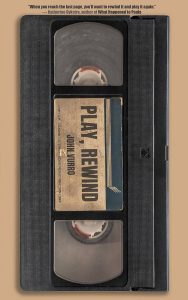
A Review by Jennifer Rivera
In Play, Rewind, John Vurro’s striking debut novel, readers are invited into the fragmented world of Wes, a twenty-six-year-old young man whose life has been reoriented around the slow unraveling of his mother’s mind. Vurro delicately balances narrative intimacy and structural sophistication, producing a work that is both emotionally affecting and formally ambitious. Set against the crumbling backdrop of a dying video rental store in Queens, New York, the novel is a meditation on memory, regret, identity, and the salvaging power of art.
Wes is introduced to us as a once-aspiring filmmaker now trapped in the liminal space between hope and responsibility. When his mother was diagnosed with dementia, he gave up his plans for film school to care for her full-time. The emotional cost of this decision, however loving, becomes the axis on which the entire novel turns. Wes is not simply a dutiful son; he is a young man increasingly defined by loss of future, of past, and of self. His mother, once his anchor, is now volatile and unrecognizable, her moods swinging sharply as her memory deteriorates. Yet, Wes continues to maintain their home in its pre-diagnosis state, as if he can freeze time and prevent the erosion of her identity.
Vurro’s portrayal of dementia is remarkably grounded. Rather than romanticize the disease or turn it into a convenient metaphor, he presents it in all its harrowing mundanity: the constant repetition, the flashes of lucidity that only make the decline more painful, the emotional labor that never stops. Wes’s caretaking is both physically draining and spiritually exhausting. His only real support comes from Gloria, a compassionate and competent part-time nurse whose presence offers structure and a semblance of relief, even as the weight of the situation grows heavier. She gently urges Wes to consider placing his mother in a home—an option he sees as both a betrayal and an impossibility, given their financial constraints.
A thread of mystery enters the novel when Wes discovers an unmarked videotape outside the store labeled “COPY DON’T WATCH. BE BACK SOON.” The tape appears to be a simple home video of a couple’s Caribbean vacation, yet it becomes a powerful emotional and narrative anchor. What first seems incidental evolves into a deeply symbolic presence in the story: a glimpse into a life untouched by obligation, a visual embodiment of joy and freedom that stands in stark contrast to Wes’s own constrained existence. Vurro uses the footage not just as a clue, but as a catalyst. This artifact awakens something long dormant in Wes’s imagination and ultimately sets the story’s emotional and creative transformation into motion.
Wes’s emotional landscape becomes further complicated by the reappearance of Lola, a high school crush who disappeared without explanation just before graduation. She resurfaces as mysteriously as she vanished, offering neither clarity nor closure. Instead, she inserts herself into Wes’s life, posing as Joan, his mother’s long-deceased sister. Her role in the household becomes an unsettling performance, one that momentarily comforts his mother but ultimately disrupts the careful equilibrium Gloria has helped Wes maintain. Lola’s refusal to share her past and her tendency to sidestep caregiving boundaries create additional strain. Yet her presence also injects a kind of chaos that nudges Wes toward emotional risk—toward change.
Vurro uses Lola’s character as a reflection of Wes’s indecision and yearning. Her mysterious past, her charm, and his intense emotions towards her all complicate the care ecosystem around Wes, forcing him to confront not only his mother’s deterioration but his loneliness. Lola’s return and her impulsive efforts to help challenge Wes’s sense of control and his reluctance to look beyond the walls of his current life. Lola’s presence also reintroduces the theme of escape. For Wes, the tape and Lola represent alternative lives: one imagined, one remembered, both infused with what-ifs.
The novel pivots when Wes decides to enter a film contest at the Manhattan Film School. With Lola’s help, he begins recording his mother’s daily life, interweaving this footage with the mysterious vacation video. The act of filmmaking becomes a vehicle for processing grief, confusion, and memory. In this way, Play, Rewind becomes not just a novel about film, but a novel structured like a film—editing together disparate pieces to create a coherent emotional narrative.
The documentary effort elicits a crucial confession from his mother: the truth about Wes’s father. Contrary to what Wes believed, his father never moved to Florida. Instead, after putting the family in danger due to gambling debts, his mother paid him to disappear. This revelation doesn’t just upend Wes’s understanding of his childhood; it exposes the fragility of the stories we tell ourselves to survive. Vurro handles this moment with quiet force, avoiding melodrama in favor of emotional authenticity.
Determined to uncover the truth, Wes tracks down the address on the lease his mother co-signed for his father. What he finds is both astonishing and painfully anticlimactic: his father, still living in New York, fails to recognize his grown son. In a further twist, Wes realizes the couple from the mysterious video—Greg and Sarah—are his father’s neighbors. The discovery is startling, but rather than wrap this coincidence in narrative certainty, he lets it remain ambiguous, inviting readers to consider whether fate, coincidence, or something more ethereal is at play.
As Wes grapples with these revelations, his caregiving responsibilities grow untenable. His mother injures Gloria, and Lola volunteers to stand in her place as caregiver. After Lola impulsively takes his mother to a casino, resulting in a public disturbance and hospitalization, Wes is forced to confront the truth: he can no longer manage her care alone. In the novel’s most tender and mature turn, he makes the difficult decision to place his mother in a care facility. It’s a decision made not from abandonment, but from love—an act of courage that acknowledges both his mother’s safety and his own right to survive.
Vurro’s prose is unobtrusive but precise. The novel’s structure—layered with flashbacks, videotape footage, documentary scenes, and real-time struggles—mirrors Wes’s internal fragmentation and gradually reassembled self. The result is a story that feels deeply lived-in, like a memory being edited as it’s told. What elevates Play, Rewind is Vurro’s stylistic control. His prose has clean, attentive, and unshowy qualities that allow the emotional weight of the story to build naturally. Dialogue is realistic and nuanced, often infused with a quiet ache. Cinematic imagery—unsurprisingly—is used with restraint, not flourish. The novel respects its characters enough not to impose meaning upon them. Instead, it invites the reader to sit in the discomfort of not knowing how long a loved one will remain recognizable, not knowing if a sacrifice will ever be rewarded, not knowing if art can truly redeem pain.
Ultimately, Play, Rewind is a novel about memory—how it fades, how it returns, and how it can be recorded, even remade, through the lens of love and art. Wes’s journey is not about reclaiming lost time, but about accepting what is and daring to hope for what might still be possible. In creating a film that blends fantasy and reality, Wes gives his mother and himself a kind of immortality.
This is a quietly powerful novel about letting go of the life you imagined in order to honor the one you’re living—and about the beauty that can emerge from the effort to preserve it.