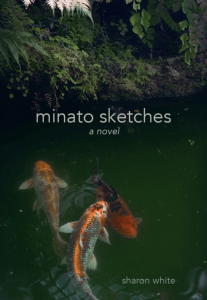
A Review by Mary Evangelisto Miller
When Gigi lands in Tokyo to begin teaching a summer-long art history seminar, she embarks on more than a professional appointment. Summer often serves as a bridge, especially for students and teachers, spanning the chasm between the end of one school year and the beginning of another. For Gigi, the summer represents even more: a rebirth. After a debilitating stroke, and years of rehabilitation, during which she was tasked with relearning how to perform basic functions—smiling, speaking, using utensils, word-finding—she is ready to reenter the world, outside the protective care of her family.
It is no accident that Tokyo is her destination. As a young student, Gigi’s period of study in Japan proved transformative, and an irresistible longing to return to that time while beginning the next phase of her life propels Gigi forward, despite her reservations. Trying life on her own, independent of her husband and sons, is the next step in her healing, as well as an attempt to reclaim something she lost inside her soul before the stroke caused her to lose her language. Postgirlhood, prestroke, Gigi lost sight of who she is beyond a wife and mother, and misses her fire, needing “this time to be a chance to reclaim some kind of wildness of spirit.”
As Gigi settles into what will be her life for the summer, she begins to reclaim herself through teaching, connecting with her students, and, in particular, through new friendships with colleagues—particularly Richard, a physics professor-turned-dance and yoga instructor. In her time off campus, Gigi explores various gardens and tends her own plants she has installed in her apartment. As the summer unfolds, her friendship with Richard becomes central to her life, as they spend many hours bonding while exploring Japanese gardens and parks together.
Recurring themes mirror the loss and renewal of Gigi’s health and vitality. Gigi frequently refers to her stroke as “lightning in her brain,” equating her medical emergency with a natural disaster. Likewise, the Japan of her youth has been transformed through the catastrophic earthquake and tsunami of March 11, 2011—a triple disaster involving a massive earthquake, devastating tsunamis, and the subsequent Fukushima Daiichi nuclear meltdown, leading to loss of life, displacement, and long-term environmental and social effects in the Tōhoku region. Tōhoku, too, is emerging from disaster; like Gigi herself, the Japan of her younger days is gone, but in the process of rising from the ashes. Still alive, but irrevocably changed.
In another metaphor for creating order from chaos, the work of Robert Smithson is mentioned throughout the novel. Smithson is best known for large-scale sculpture and land art; his focus was on transforming ruined or exhausted sites in nature into something new—much like post-lightning Gigi, or post-3/11 Japan. The wild boars that are thriving in the desiccated landscape in high-radiation zones in Sendai serve as another example of adaptation after a cataclysmic event. Gigi’s ongoing fascination, and eventual encounter, with these wild boars show her affinity for these creatures, which mirror her own strength and resilience.
Minato Sketches is a beautifully written novel. The fleshed-out descriptions of the gardens and flowers Gigi loves, as well as the still-recovering landscapes she visits, lend vitality to the text. The chapters are concise; like the still-recovering processes of Gigi’s brain, each chapter comprises sketches of time, rather than completed artworks. The voice and language are clear and simple. The multilayered structure of the novel creates interest throughout the novel as different elements of the story unfold. Through Gigi’s experiences, as well as the narrative, the reader learns details about Japanese culture and society that add heightened texture and meaning to Gigi’s experience.
In Japanese, Minato (港) means “harbor” or “port,” symbolizing safety, cultural exchange, and connection. The character 港 visually depicts water enclosed by structures, signifying a safe haven for ships. In Minato Sketches, for Gigi, the Tokyo summer is precisely that: a place of safety during her progressive healing; a place of exchange of what she was before the stroke for what she is becoming now; a place of new connections, not only with new people, but with Japan, as a metaphor for her own rebirth after disaster. As we follow Gigi on her journey, we are reminded of the fragility and power of change. What does not kill us may not necessarily make us stronger, but it will change us, and we must find a way to forge ahead.
Mary Evangelisto Miller is a freelance writer and editor based in Bucks County. She has been self-employed as a medical editor for 23 years. Mary holds a bachelor’s degree in Mass Communications and English from Temple University and a master’s degree in English and Publishing from Rosemont College.